Protecting an Island Paradise

Thursday December 17, 2009
Posted by Conor Mihell
The Nature Conservancy of Canada (NCC) has brokered the largest conservation deal in Ontario history by raising $7.4 million to purchase a 1,900-hectare, eight-island archipelago in northwestern Lake Superior. NCC partnered with The Nature Conservation of the United States and the Ontario and federal governments to acquire Wilson Island, which is surrounded by the protected waters and lakebed of the Lake Superior National Marine Conservation Area (NMCA). Read the full article…
Winter 2009

Power Struggles
Climate change demands that we develop alternative sources of renewable energy. Queen’s Park is pushing hard to increase the use of biomass — fuel from crops, grasses and wood pellets. But even green power comes with an environmental price tag.
By John Lorinc
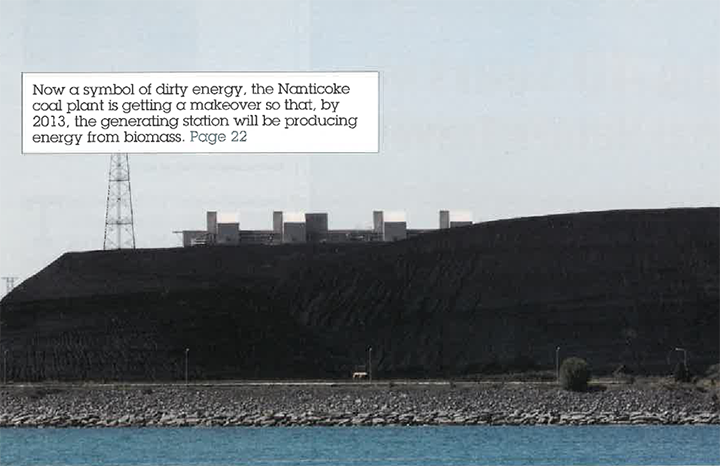
Sixty kilometres southwest of Hamilton, the Nanticoke Generating Station looms over the north shore of Lake Erie. Long before its 200-metre-high smokestacks come into view, heavy power lines appear in the fields east of Highway 6 – high-voltage tethers linking southern Ontario and the Greater Toronto Area with a coal plant that has become a symbol of the dirty energy Ontario says it no longer wants.
In 2007, the provincial government promised to stop using coal for electricity production by 2014. Ontario Power Generation (OPG) has been preparing for that transition, and out behind the station, Nanticoke OPG manager Tom Lumley shows off what the utility hopes will be its future. Between the towering stacks are two lime green silos, constructed in 2008 to hold a flour-like substance made from ground wheat stalks. Each silo holds 50 tonnes of this “biomass” dust, which gets pumped into one of Nanticoke’s eight generating units. There, it burns, along with pulverized coal, in a process called “co-firing.” The resulting heat produces steam to run the turbines.
OPG says that by 2013, it will have converted two of the eight generators at Nanticoke to using renewable biomass fuel instead of coal. The Crown corporation has similar plans for the Atikokan Generating Station, west of Thunder Bay, and possibly a unit or two at the Lambton Generating Station, outside Sarnia. As Ontario moves toward using energy from renewable sources, OPG officials hope to create a clean, green raison-d’être for these aging power stations. The alternative is to close Nanticoke, eliminate 600 jobs and mothball a costly asset.
The revamped Nanticoke station will house a new facility for the safe storage and handling of biomass fuel pellets, which will probably be made from wood, crop waste or prairie grasses. But the plant’s main systems – turbines, steam pipes, and the precipitators that capture ash – will not change significantly in the transition to biomass. Lumley, the engineer overseeing the conversion, ducks inside the rumbling station to point out how the pipes from the biomass silos snake toward the inferno of the Unit 4 boiler. “With wood, we’ll have to make minor modifications to the boiler, but I don’t see any real issues.”
Yet many environmentalists do. While biomass fuel is more environmentally friendly than coal or oil, its use still inflicts an ecological toll on the lands that provide the organic material, and so raises questions about the unintended consequences of a renewable energy policy. OPG’s plan to burn biomass to produce about 2 percent of Ontario’s electricity means that the utility and its suppliers will need to remove huge quantities of valuable organic matter from forests and farmlands. No one yet knows how much land will be affected, a troubling fact given the government’s pledge to protect working farms in the south and the boreal forest in the north.
Environmental groups also worry about the broader consequences of OPG’s move, which is playing out against the backdrop of the international climate change conference in Copenhagen in December 2009. In all likelihood, the utility will be only one prospective customer for the province’s nascent biomass industry. Queen’s Park is pushing the biomass plan as a means of refuelling the hobbled timber sector, which would be called on to supply hundreds of thousands of tonnes of wood pellets to OPG, and, potentially, to utility customers in Europe and the United States. Ontario Nature, and others, are warning that neither Queen’s Park nor OPG have ruled out the use of peat – a rich wetland substrate that many consider to be a fossil fuel – as a potential source of biomass. “The forest industry is in big trouble, so it’s little wonder that people are ready to grab on to alternatives as quickly as possible,” says Ontario Nature’s senior director of conservation and education Anne Bell. “But we don’t fully understand the potential consequences, and that’s dangerous.”
On paper, the case for biomass looks promising. When organic material – such as straw, branches or wood chips – is transformed into fuel and burned to run turbines or engines, the combustion process releases greenhouse gases (GHGs). But because the fuel came from harvested organic matter that will eventually regenerate by absorbing carbon dioxide, the net result is carbon neutral due to the cyclical nature of the process. With fossil fuels, by contrast, the carbon has been trapped for millions of years below the ground, and its release increases the overall GHG concentration in the atmosphere.
While replanting, harvesting and processing are all activities that consume energy and generate additional GHG emissions, those emissions appear to be dramatically lower than amounts that traditional fuel sources produce. According to a “life cycle assessment” that Heather MacLean, a University of Toronto professor of engineering, conducted for OPG, the total GHG emissions associated with biomass fuel pellets are just 9 percent of those produced by mining and burning similar quantities of coal.
But the biomass story is complicated. For example, when burned, some crop biomass leaves behind residues that damage the boilers. Wood pellets throw off highly flammable dust, as Atikokan workers discovered in December 2008 when a load of wood pellets ignited, damaging the plant (similar events occur in flour mills). While no one was injured, OPG engineers learned that static and dust must be minimized in biomass storage facilities. As Chris Young, the OPG vice-president overseeing the biomass project, acknowledges, “a lot of people in the biomass industry worldwide have experienced explosions.”
Cost is also a problem. Wood pellets are more expensive to produce than coal yet, in general, contain only half as much energy, because carbon is far less concentrated in wood pellets than in coal. OPG will need the Province to guarantee higher rates to support OPG’s shift to biomass, as is the case for solar and wind energy producers.
The other challenge is the current lack of a pellet industry in Ontario. Even so, when OPG put the word out last winter that it was seeking pellet producers, more than 80 firms responded, over half of which are in Ontario’s timber industry. In 2010, the utility will begin asking companies to bid on supply contracts.
Queen’s Park is pleased with the industry’s response. “One of the real goals is to support a new bio-economy,” says Minister of Northern Development, Mines and Forestry Michael Gravelle, who represents the riding of Thunder Bay-Superior North. “There’s certainly some export capability.”
The New World Order

Global warming affects everything – there are no isolated instances. From increased frequency and intensity of forest fires in the northwest, to beach and dune erosion along the Great Lakes’ shorelines, to flooding around the Thousand Islands, every corner of the province could be profoundly altered by climate change. How will our wildlife feel the impact of rising temperatures? Some, like the snow goose, seem to be benefitting from a greater range of habitat, while others, such as wood frogs, could be frozen out. Here are some highlights of what’s to come.
By Allan Britnell
Black and white spruce are much more than iconic conifers; as well as being prized for their timber, spruce forests provide winter shelter for caribou and moose and their seeds sustain a diverse group of birds and small mammals. These trees also attract an eponymous pest, the spruce budworm, a moth whose larvae feeds on their shoots. While the population of this native moth ebbs and flows over a 30- to 40-year cycle, recent outbreaks have been defoliating large swaths of forest north of Lake Nipissing and along the St. Lawrence River, two areas where the insect had not previously been a significant problem. The spread cannot be attributed conclusively to climate change, but it is suspected of being a leading cause, and Canadian Forest Service researchers predict that climate change will lead to “prolonged, severe outbreaks of spruce budworm.”
Warmer boreal temperatures are also projected to increase the range of fast-growing species such as birch and aspen, as well as a number of invasive species, all of which could crowd out spruce saplings.
The sugar maple could one day be more commonly found on our flag than in the wild. A 2005 World Wildlife Fund report on the implications of a global temperature increase of 2 C by the middle of this century concluded that, according to various models, sugar maples were one of several “commercially valuable species [that] showed consistent declines.” (Others include black spruce and Jack pine.)
Such a drop would not only be bad news for the forestry industry, but could also have negative effects on a number of creatures that inhabit sugar maple forests. The trees’ seeds, leaves and bark are food sources for squirrels, porcupines, deer and countless insects; the trunk and leafy canopy provides nesting sites for black-capped chickadees, pileated woodpeckers and screech owls. The deep roots of the sugar maple draw water up close to the surface of the ground and then release it into the surrounding soil at night, where it can be taken up by shallow-rooted understorey plants.
We humans would also suffer: if freezing cold nights do not follow warm days in early spring, the trees cannot produce the sap required to make maple syrup.
Pelee Island’s latitude – south of the 42nd parallel, the island is at the same level as California’s northern border – and the moderating effects of Lake Erie combine to give the 47-square-kilometre land mass one of the mildest climates in the country, making it a suitable home for the endangered eastern prickly pear cactus. The flat, green, spike-covered oval pads of this plant are reminiscent of one that you would find in a southern desert, while its edible, pear-shaped fruit is a juicy treat for small mammals such as rabbits, whose droppings are the plant’s primary means of seed dispersal.
But the shade-intolerant species grows only in dry, sandy soils in a zone between the water’s edge and leafy inland vegetation. Intense winter storms, which are increasingly projected, could soon wash this cactus right out of Canada.

Farming for the future

More heat may increase food production. It might also accelerate plant diseases, spoilage and soil erosion. How can farmers prepare for global warming?
By Ray Ford
Beyond the wind-whipped spruces and past the chain-link fence, the tidy brick homes on London, Ontario’s Webster Street, are still firmly in 2009. But just metres away, in a field of browning grasses that rustle like paper, Hugh Henry offers me a guided tour of the future.
“People will look at this and say, ‘Hey, global warming’s not so bad. This stuff is still growing,” the University of Western Ontario biology professor says. “But I’m interested in the threshold effect. You can push the system very far and have very little happen. But if you push it past a certain point, you have a major impact.”
Henry is pushing the field toward 2050, feeding $7,000 worth of hydro every year into heat lamps that droop above the plots like sunflowers. When he switched on the power in the fall of 2006, he hiked the temperature in parts of the field by 2 C to 3 C. It was instant global warming, in the range we are likely to experience in Ontario in just 40 years, when the world is not only warmer but hungrier – and when buying whatever you want to eat, whenever you want it, is a fond memory.
That seems hard to believe in a country with a 23 percent obesity rate, where shelves are lined with exotic delicacies from around the globe and where each of us wastes an average of 183 kilograms of food a year. Most farmers feel the same way. When University of Guelph researchers interviewed producers in Ontario’s agricultural heartland, they found them “generally unaware of or, in many cases, unconcerned about the potential effects of climate change.” Global warming “doesn’t keep me up at night,” said one dairy farmer. “In the short term, I would be more concerned about interest rates.” By the time climate change affects the farm, added another, “it will be so far down the road that I will be long forgotten.”
Could a couple of degrees of warming over a few decades really change the bounty we’re accustomed to? And even if it does, is there anything we can do now to prepare?
At the close of this past summer of discontent, when near constant showers blighted tomatoes and leached the goodness from hay crops, I decided to find out. I left my own farm hard by the northwestern corner of Algonquin Provincial Park for a motorcycle trip into the future. My destination: Henry’s field and the nearby Biotron Experimental Climate Change Research Centre.
Heading south through Ontario is like putting climate change on fast-forward. As David Pearson, a Laurentian University geologist and co-chair of Ontario’s Expert Panel on Climate Change Adaptation, explains, for every degree the climate warms, it’s as if the regional climate migrates 200 to 300 kilometres north. Given that our current rate of belching greenhouse gases will warm the province by about 2 C in the summer and 3 C in the winter by 2050, summer in southern Ontario will feel more like it does today in central Ohio.
So as I ride through the granite rock cuts of Highway 11, angle southwest across the limestone near Orillia and head through the corn and soybean fields of Perth and Middlesex counties, I enter the kind of humid, sultry weather that will be a lot more common on my farm by mid-century.
Looking at these expansive barns and fertile fields, it’s easy to see warming as an advantage. In my neighbourhood and further north, grain corn will go from being a gamble to a reliable crop. How about Manitoulin Island as Ontario’s next major wine region? According to the latest report from the Intergovernmental Panel on Climate Change (IPCC), farmers in northern countries like Canada will see a net benefit. But, as with any system that relies on biology, agriculture is a complex process – one in which adding more heat does not automatically guarantee more food. More heat could also lead to more plant diseases and spoilage, or more soil erosion. Or more visits from Jeremy McNeil’s favourite subject, the armyworm.
McNeil, the scientific director of the Biotron Experimental Climate Change Research Centre in London, specializes in studying the dun-coloured moth that hitchhikes to Canada on winds from the southern United States. When the moth’s eggs hatch and the conditions are just right, regiments of larvae – armyworms – emerge to chew their way through grasses, leaving a forest of leafless stalks in their wake.
“When I started studying them in the 1980s, outbreaks came every three to 20 years,” says McNeil. In the past 15 years, however, there have already been four or five outbreaks, an intensification of the pattern. “We’re not sure why,” he says, opening an incubator the size of a walk-in closet, where thousands of worms are housed in individual containers. “Maybe the winds are more favourable. Maybe milder winters help, too. It could even be chance.”
McNeil wants to see what the worm will do in the future, because – as the mountain pine beetle has proven in British Columbia – a single pest unleashed by global warming can have a devastating effect. Cold winter nights used to keep this beetle in check. When winters warmed, the beetle population exploded, chewing through half of British Columbia’s mature pine forest.
For the armyworm and other migratory insects, the issue isn’t winter chill but timing. As autumns become warmer, will the moth head south, or will it linger only to fall prey to the first killing frost? There are similar questions about pollinators including hummingbirds, butterflies, bumblebees and mosquitoes: Will they arrive on time to pollinate plants, or will the warming encourage them to show up too soon or too late to ensure that plants produce fruit?
When the Biotron is fully operational late this year, scientists can probe these issues by staging complex simulations in its “biomes” – rooftop greenhouses where scientists can control the heat, rainfall and carbon dioxide levels and watch their impact on soils, microbes, insects and plants.
The process is not simple. “You can’t just throw the armyworm of today into a chamber that represents 2025,” says McNeil. “We’ve got to mimic the evolutionary changes the worm will be exposed to during the next 15 years.” To do that, McNeil and his students would have to breed generations of armyworms in increasingly hot environments with higher carbon dioxide levels, in an attempt to produce the type of pest farmers will battle decades from now.
By simulating the future in a greenhouse, McNeil hopes to “get the answers ahead of time,” warning farmers of the challenges they will face in a greenhouse world.
Henry’s field is another sort of early warning system. As he explains the layouts of these plots in a neglected corner of Agriculture and Agri-Food Canada’s research station in London, I study the grass and rub the earth between my fingers. If this is the future of my farm, will I be able to make a living from this ground?
I’m comfortable on my own northern clay, understand it and know how to work with it. But I am not sure what to make of this lighter London land, with its heavy layer of thatch above the earth, its crown of rank, overmature grass. It seems somehow less lively than the earth at home. Is that due to the impact of Henry’s experiment, or simply my own unfamiliarity with the soil?
But farmers are optimists. With some tender loving care (in the form of manure, more legume seed and rotational grazing), I could probably work with this soil – all else remaining equal.
The problem, as Henry reminds me, is that things are unlikely to remain equal. Along with the extra warmth from the heat lamps, he is adding nitrogen to simulate the effects of all the nitrogen-laden pollutants that will be pumping out of tailpipes, smokestacks and fertilizer and manure piles by 2050 if fossil fuel use continues to grow as expected.
In theory, all that extra heat and nitrogen should help plants thrive – an effect the IPCC is banking on when it assumes that the warming climate will make Canadian farms more productive. But some plants may thrive more than others, including what Henry calls “weedier, more aggressive” species that will take advantage of the hotter, drier, more nitrogen-rich environment. Kentucky bluegrass and smooth brome are already outgrowing some of the more nutritious clovers and trefoils in the plots.
Northern exposure
By Douglas Hunter
Northern Ontario residents witnessing forestry companies’ large-scale spraying operations carried out from helicopters want to know why an activity that is considered harmful in the south is acceptable in their neck of the woods.
Opposition has been growing to the use of products containing glyphosate, the active herbicide in weed killers such as Roundup. While such products are now forbidden under the new Cosmetic Pesticide Ban Act, except as a control measure for noxious plants such as poison ivy, the Ontario Ministry of Natural Resources (MNR) has permitted forestry companies to conduct aerial spraying of large areas with the glyphosate-based herbicide Vantage Forestry. A fact sheet from Dow AgroSciences on Vantage Forestry says that it “provides non-selective vegetation control, i.e. ends growth of almost all species of weeds and grasses that compete with trees in reforested areas … On contact with the soil, glyphosate binds very tightly to soil particles and there is very low leaching potential to groundwater. In the soil, Vantage Forestry is degraded by natural processes into harmless compounds.”
Quarry given the green light
By Douglas Hunter
On July 15, the coalition group Citizens Concerned for Michipicoten Bay (CCMB) lost a seven-year fight against a proposed traprock quarry on the eastern shore of Lake Superior. The Ontario Municipal Board (OMB) declined to overturn an amendment the municipality of Wawa made to its official plan that allows Superior Aggregates Co. to open the quarry on 35 hectares of rezoned shoreline property.
The quarry site is located less than five kilometres from Michipicoten Provincial Park and 6.5 kilometres from a provincial conservation reserve.
What the Prime Minister has to say about climate change
“[The greehouse effect is] a scientific hypothesis, a controversial one and one that I think there is some preliminary evidence for. This may be a lot of fun for a few scientific and environmental elites in Ottawa, but ordinary Canadians from coast to coast will not put up with what [the Kyoto accord] will do to their economy and lifestyle, when the benefits are negligible.” September 2002
Bringing back the chestnut
By Allan Britnell
Reforesting vast swaths of eastern North America with a hybrid version of the American chestnut (Castanea dentata) could lead to a revival of this endangered species, as well as offer a potential solution to climate change.
The towering icon, which can reach heights of 30 metres, was once the dominant species in many forests throughout the eastern United States and southern Ontario. But in the 1920s, the chestnut blight fungus, probably introduced by imported Asian chestnut trees, reached Ontario, and by the middle of the century the disease had killed around four billion trees (1.5–2 million in Ontario alone), virtually wiping out the species in North America.
Seeds of discontent
By Bob Gordon
Located in Kingston, Frontenac Institution is a minimum-security federal prison that includes one of six prison farms operated by Corcan, the employment training arm of Corrections Services Canada (CSC). For more than 60 years, inmates have farmed its 360 hectares. The Kingston area is home to a cluster of CSC institutions that benefit directly from the low-cost eggs and milk produced at Frontenac, as do local food banks that receive food donations.
Government approved sprawl
The environmental assessment (EA) process, which is explored in “Why we can’t save this forest” [Autumn 2009], was created, in essence, to protect important ecological attributes. The sad fact is that now it is used to “green light” controversial developments.
The most disturbing case where the EA process has been misused is for the approved development of a whole new city called Seaton. This city is to be built between Toronto and Pickering, and is projected to match the size of Peterborough, at 70,000 citizens. The marketing push for the project is a pure greenwash, as it is being touted and sold as a “green” community. However, if built, the format will be the usual low-density sprawl. It would be built on top of Duffins Creek, the last remaining healthy watershed on the entire north shore of Lake Ontario. Currently the area is in pristine condition and is home to species lost to most other watersheds in the Greater Toronto Area because of pollution and overdevelopment. The fields and forests comprise the largest tract of true green space left in the region and [are] home to a multitude of local and migratory species that no longer have suitable habitat left in this part of southern Ontario.
I spent months attending the public consultations for the EA process for Seaton. I spent hours reading through plans, making notes and recommendations about the effects building would have on the environment and watershed. Other community members and I brought forth important ecological information, such as numbers of mammals and other species documented as living on the proposed development site. Virtually none of our concerns were acknowledged or dealt with, and the proposed plans were approved in haste. Now the future city of Seaton will destroy what little nature is still left in the already overdeveloped GTA. What we truly need is more protected green space, not more cities and suburbs.
Bernadette Zubrisky, Agincourt
Questionable methods
There is no disputing that agricultural pesticides can significantly impact wildlife populations, including passerine songbirds. And there is no disputing that apple orchards in Ontario receive more pesticide treatments than most other crops. However, as a lifelong naturalist, and as a biologist that has been involved in developing pesticide reduction strategies for apple orchards for 25 years, I feel I need to point out some serious errors in the Bishop study described in “The killing fields” [Autumn 2009] regarding impacts of pesticides on tree swallows and eastern bluebirds, which lead to some gross misrepresentation of the results.
First some facts: One, the 12,000 hectares of apple orchards in Ontario represent only 0.16 percent of the 7.4 million hectares of prime agricultural land in the province. Two, cavity nesters like tree swallows and eastern bluebirds do not normally nest in orchards, nor do they regularly forage in orchards. Tree swallows are aerial foragers and bluebirds are grassland species that prefer open meadows and pastureland for foraging. And three, the Bishop study was conducted in two Brant County apple orchards in which bluebird nestboxes had been installed.
Based on the above facts I would argue that the levels of exposure to pesticides in the two bird species were greatly magnified and artificial (not a real-life situation). To make conclusions on impacts of pesticides on these two species in the context of artificial nesting sites in commercial apple orchards is misleading and results in exaggeration. The real issue here is the exceedingly poor decision of a well-intentioned naturalist to persuade an apple farmer to put up bluebird next boxes in an orchard, thus needlessly exposing these birds, including adults, eggs and young, to unacceptable and unnecessary risk. Perhaps if these studies had been conducted on robins, mourning doves or chipping sparrows, which do occasionally nest in orchards, there would be a stronger scientific argument to Bishop’s methodology.
Bernie Solymar, EarthTramper Consulting Inc., Port Ryerse
An ill wind
The Province’s green energy act isn’t so green when wind farms threaten sensitive habitat and wildlife.
By Douglas Hunter
In November 2008, environmental groups and the energy industry south of the border announced a remarkable collaboration. They formed the American Wind Wildlife Institute (AWWI) with the aim of ensuring that locations for wind farms are selected with sensitivity to ecosystems and endangered species, while also developing “best practices” for the wind-power industry. Signing on were such leading environmental groups as the Audubon Society, the Sierra Club and The Nature Conservancy (TNC). Everyone agreed that wind turbines are an important part of the green energy mix, capable of reducing pollution and combatting climate change. But everyone also agreed that wind farms can have a serious negative impact on the environment if put in the wrong place or configured in the wrong way.
Conservationists in Ontario can only look on with envy. Wind-farm developers here do not have to cater to environmental concerns because of the provincial government’s gung-ho green-energy agenda. Under the revisions to the Environmental Protection Act this past spring, a hearing to voice concerns about a green-energy project can be secured only in the case of projects that, if approved, might cause “serious harm to human health; or serious and irreversible harm to plant life, animal life or the natural environment.” That sets the bar perilously high: presumably a wind farm can be permitted to do serious harm if it can be argued that this harm is not irreversible. As for chronic, low-grade impacts whose ultimate consequences may be unknowable, forget about them. The green revolution is rolling right over those.
With the passage of the Green Energy and Economy Act last May, the Province signalled that it would no longer tolerate grassroots opposition that smacked of NIMBYism. To get green developments (along with the flood of envisioned jobs) moving at top speed, municipalities were stripped of their planning powers on such projects. In this climate of aggressive fast-tracking, there is simply no imperative to create a Canadian equivalent of the AWWI.
In fairness, the actions of many local opposition groups invited this type of legislation. Too often, such opponents reflexively opposed change, prattling on about property values, distributing misleading or out-of-date “evidence” of the evils of “industrial” wind farms, and talking trash about climate change. Unfortunately, in the process of cracking down on ill-informed or short-sighted critics, legitimate wind-farm issues have been swept aside.
There are good reasons to be concerned about the impacts of wind farms. An article in the Autumn 2009 issue of TNC’s magazine recounts how the Elk River Wind Project in Kansas invaded one of the last surviving examples of wild prairie in the state before the local TNC chapter could do anything to stop it. “What had been nearly 8,000 acres of low impact ranch land in one of the most threatened habitats in the world was now sliced by 20 miles of roads, 100 towers, transmission lines and a sizable electrical substation.” TNC, as part of AWWI, is now working to steer the state’s green-energy boom away from such locations. Such work is going on across the United States.
Whether an Ontario project equivalent to Elk River would meet the new test of threatening “serious and irreversible harm” to the environment, I cannot say. We are now largely dependent on the wisdom of provincial bureaucrats to permit or prevent green-energy projects. And environmentalists, to a large degree, have lined up wholeheartedly behind the green revolution. They, too, want to see the coal-fired plants taken off-line pronto and are sometimes a little too ready to agree that voices of concern in rural Ontario are just selfish natterings from the tiresome NIMBY crowd.
In some ways, “green energy” is a misnomer. Such projects can do tremendous good in reducing pollution and combating climate change, but they can also have tremendous negative impacts on natural spaces. Witness Ontario’s historic enthusiasm for that other “green energy” marvel, the hydroelectric dam, which has rendered numerous waterways unrecognizable, flooded vast tracts of land and even reversed courses of rivers. There is more to being green than not spewing carbon dioxide. And while wind power deserves to be part of the new energy mix, it does not deserve carte blanche to commandeer any spot bureaucrats and developers say it should. Ten years from now, we may be looking to our U.S. neighbours in envy, wondering how they got their green energy infrastructure so right when we got ours so wrong.
Douglas Hunter is the author of Half Moon published by Bloomsbury Press. His last story for ON Nature was about aquaculture (“Muddy waters,” Summer 2009).
The big picture
By Caroline Schultz
This issue of ON Nature is focused on climate change against the backdrop of the December 2009 conference in Copenhagen on worldwide strategies to combat global warming. So it’s an opportune time to consider what Ontario Nature is doing to address this vast issue in our own backyard. Individuals and organizations have rallied to the cause, sending petitions to politicians, staging events and flooding decision-makers with calls and letters urging governments, including our own, to respond to this unprecedented environmental crisis.
Such outreach efforts are extremely important – the more noise, the better. Will we look back and describe December 7 to 18 as the two weeks that changed our ecological destiny? Or will we regret a squandered opportunity that condemned life on this planet as we know it? An overall average increase of 4 C means temperatures will rise by 2 C in some places and 12 C (or higher) in others, rendering them uninhabitable. Computer models show the Arctic warming by 15 C.
Now is the time for action. Scientists say that 350 parts per million (ppm) of carbon dioxide in the atmosphere is the safe limit for humanity. Right now the atmospheric carbon dioxide content is 387 ppm, and trending up. At Ontario Nature, we understand that conserving and protecting a healthy landscape on a large scale is a critical part of the solution. That is why protecting forests is so crucial: after all, forest destruction is one of the largest contributors to global warming.
In Ontario, the massive northern boreal ecosystem is larger than California and stretches from the end of the road system, north to Hudson Bay. It is nearly pristine and still functions the way nature intended, providing habitat for all manner of wildlife, and capturing and storing an enormous amount of carbon in its forests and peatlands. Across Canada, the boreal region stores 186 billion tonnes of carbon.
Last year, Ontario’s Liberal government promised to protect 50 percent of the northern boreal region. Ontario’s commitment sets a high standard for conservation and the protection of biodiversity in this era of climate change, and it is imperative that this promise be implemented as soon as possible.
Queen’s Park is also looking closely at the use of biomass – crop waste, grasses and wood pellets – as an alternative source of renewable energy (“Power struggles,” page 22). But this approach is not trouble-free. Environmentalists are concerned by how much land would be needed to grow so-called energy crops, and how much forest “waste” would need to be hauled out of the bush for pellets. Because every part of a tree can be turned into pellets there is a great risk that debris such as branches and foliage will be removed and, with them, nutrients essential for forest regeneration.
No single solution to climate change exists. Saving a huge swath of our healthy, intact northern landscape, however, is a critically important first step.
Unwelcome visitors
By Sharon Oosthoek
Fisheries biologists have unexpectedly discovered round gobies in the Thames, Sydenham, Ausable and Grand rivers and are now sounding the alarm over how this invasive fish may affect endangered species.
The Great Lakes tributaries, Canada’s most diverse aquatic ecosystem, were long thought to be immune to such an invasion because, since each ecological niche was taken up, invaders could not gain a foothold.
A natural gem
This fall, Ontario Nature hosted a well-attended conservation fair at its Cawthra Mulock Nature Reserve in partnership with Ontario Power Generation (OPG). The fair, which attracted some 350 participants, was one of 10 events that Ontario Nature co-sponsored with OPG in 2009. Each is intended to connect families from urban and suburban areas across the province with nature.
“We were thrilled with the success of the day,” says Caroline Schultz, executive director of Ontario Nature. “To see so many families getting involved and the excitement of the kids was just what we had hoped for.”
For the eager naturalist, exciting activities abounded. Birdbox building was a popular choice, and participants learned how to construct boxes and then erect them around the meadows and wetlands of the reserve. Local visitors were pleasantly surprised that such a naturally rich and large area – one integral to the York Region Greening Strategy and home to species such as great blue herons, red-tailed hawks and great horned owls – was so close at hand.
“The Cawthra Mulock Nature Reserve represents a gem within Ontario Nature’s broader greenway vision that provides families with a wonderful opportunity to experience nature in a rapidly growing urban environment,” says Cara Clairman, vice-president of sustainable development at OPG. “One walk along the trails at Cawthra Mulock will reinforce the need to protect what sustains us.”
The Ontario Veterinary College in the Wildlife Environment and Education Program at the University of Guelph presented its hugely popular raptor showcase at the fair. Visitors got up close and personal with majestic raptors, including a turkey vulture, a broad-winged hawk and a great horned owl. For many people, seeing such birds, let alone observing them within arm’s reach, was a first.
Lake Simcoe Region Conservation Authority brought a demonstration model that showed how water and pollution move through a watershed, and the importance of keeping them healthy. Fittingly, another popular activity allowed visitors to participate in the restoration of the reserve’s stream channel, which involved placing stones along the stream course to stabilize its banks.
Mike Van Tilaart from the York-Simcoe Naturalists led 70 or so people on guided hikes around the reserve. The crowd spied preying mantises, shield bugs, painted turtles, leopard frogs and toads. Other activities included button making and face painting, a reptile and amphibian scavenger hunt, and creating bird feeders from pine cones.
For many people, the event was an introduction to Ontario Nature and its nature reserve system. Numerous visitors remarked on what an informative, engaging and fun experience it was. Many inquired whether this unique setting was open to the public. (It is! Visit Ontario Nature’s website for directions and access instructions to Cawthra Mulock and other nature reserves.) The fair also piqued people’s interest in Ontario Nature conservation projects, as well as OPG’s Biodiversity 2009 initiative.
“Ontario Power Generation has been a very important supporter of the ecological restoration work on a number of our reserves,” says Schultz. “So it was very fitting that this event sponsored by OPG’s Biodiversity Program was held here.”
“We at OPG believe we all have an important role to play in conserving and stewarding nature,” says Clairman. “We are pleased to partner with organizations like Ontario Nature that share our interests and have the capacity to educate families on our dependence upon and connectedness to nature. Our youth will be our future stewards. Engaging them now is a wise investment for our collective future.”
The conservation fair was one of many educational events Ontario Nature holds throughout the year. Visit the Ontario Nature website for updates on more events like this one scheduled for 2010. Full listings of OPG-sponsored events and event photos can be found at OPGbiodiversity.ca.
Our Clubs: Happy Anniversary
This year, many groups in Ontario Nature’s Nature Network are celebrating milestone anniversaries. We’d like to celebrate the 25th anniversary of five member groups that are committed to protecting Ontario’s natural landscape.
In 1984, the Carolinian Canada Coalition (CCC) identified 38 sites – totalling 16,500 hectares – across southwestern Ontario as critical natural areas. Since then, CCC has worked closely with government and nongovernment groups to secure these sites and to protect the biodiversity in the Carolinian region that stretches between Toronto and Windsor. CCC is a vital link between public and private stewardship and between grassroots initiatives and government programs.
The Essex County Field Naturalists’ Club (ECFNC) promotes the conservation of the diverse natural landscape of Essex County and the surrounding region. ECFNC was essential to the acquisition of Ontario Nature’s magnificent Stone Road Alvar Nature Reserve, a 42-hectare property of oak-hickory woodland, red cedar savannah and open alvar communities. The club remains the official steward of the property, which also features an abundance of downy woodmint, a plant that in Canada is confined to Pelee Island.
Development in the Kawartha Lakes region over the last 100 years has been devastating to osprey habitat. Pressure from new infrastructure means that the spectacular raptor must occasionally nest in perilous conditions, for example, on live-cable poles and television towers. Friends of the Osprey-Kawartha Lakes has worked for 25 years to educate the public about osprey conservation. This year, the club participated in bird tracking with Bird Studies Canada and will use the resulting migration data in future conservation projects.
The North American Native Plant Society (NANPS) uses educational outreach to inspire in people an appreciation of North America’s native plants. Continent-wide, human impacts have contaminated and destroyed natural areas, resulting in drastic reductions of native plant populations. Invasive species such as garlic mustard and buckthorn are degrading what remains. The goal of NANPS is to facilitate the restoration of our native plant life through such programs as the organization’s seed exchange. Members donate seeds and NANPS sells them at low cost to people living in bioregions in which the plants are appropriate.
Named for renowned naturalist Charles Macnamara, the Macnamara Field Naturalists’ Club (MFNC) explores and conserves the rich natural landscape of the lower Ottawa Valley, an area that the club’s website refers to as a “natural oasis”:“No matter where we roam, there is always something new to discover and enjoy.” The club has achieved a number of conservation wins, including the successful release of peregrine falcons, surveys of rare plants and animals, and maintaining the Macnamara Nature Trail and its numerous winter birdfeeders.
We thank all our dedicated member clubs for their longstanding commitment to the protection of wild species and wild spaces across Ontario.
Chimney swift

A once familiar urban dweller, Ontario’s latest official bird at risk is in free fall and global warming may be the key cause.
By Tim Tiner
Unlike most imperilled species, Ontario’s newest official bird at risk is a high-flying ace long familiar in the cities and towns of the province. In September, Queen’s Park declared the chimney swift a threatened species, six months after the federal government formally gave it the same status nationally. As swift populations plunge across eastern North America, researchers are racing to untangle the mysteries and misperceptions about this unique bird.
Migrants from the Amazon, chimney swifts are dark, long-winged, stub-tailed little birds that arrive in Ontario in late April and early May. When not tending to their nest, they are constantly airborne, swirling and chasing down flying insects on stiff, flickering, crescent-shaped wings. Swifts have tiny, weak legs but stout, strong claws, with which they cling to any rough vertical surface, bracing their spine-tipped tails against it.
These birds once nested and roosted primarily in large, broken-topped hollow trees, using their glue-like saliva to hold together their semicircular nests and paste them to the trees’ inner walls. As old-growth forests fell to settlement, swifts began to nest in chimneys – not used during the warm months – in the new homesteads. A chimney contains only one nest, but may also shelter nonbreeding swifts, including one or two “helpers,” sometimes offspring from the previous year, that in about a third of nests assist parents with nesting duties. Swifts also sometimes occupy air shafts, grain silos and the darkest corners of barns and abandoned buildings. After nesting and before and during migration from late July to early October, many swifts gather in bigger roosts, sometimes as many as hundreds in a single large chimney.
With the switch to gas and electric heating since the 1950s, however, chimneys have become too small for the sooty-hued birds. Old chimneys have been capped, wired over or lined with sheet metal, to which the birds cannot attach their nests. Most of the remaining suitable chimneys – largely on old churches, schools and commercial and industrial buildings – are also rapidly being closed, lined or demolished.
The Canadian Wildlife Service (CWS) estimates the provincial population of chimney swifts at less than 12,000 breeding birds, representing more than 60 percent of all Canadianswifts, which range from eastern Saskatchewan to the Maritimes. Their numbers are falling fast, though, especially in northern climatic zones where the rate of chimney deterioration and conversion is highest. According to the annual Breeding Bird Survey, Canada’s chimney swift population has declined by 96 percent since 1968, and decreases in Ontario over the past decade are close to 20 percent of the population each year. The Atlas of the Breeding Birds of Ontario (2001–2005) reported the species in only about half the number of locations in which it was found in the mid-1980s.
What you can do
Ontario SwiftWatch is looking for volunteers to monitor chimneys occupied by swifts across the province.
Contact Hazel Wheeler, Bird Studies Canada (Swift Monitoring) at hwheeler@bsc.eoc.org; 1-888-448-2473, ext. 165.
Surveys of remnant old-growth deciduous forest stands in Wisconsin and New York State report 18 to 20 large snags – potential swift nest trees – per hectare, which, by CWS reckoning, is more than 100 times the average density of chimneys in eastern North America a century ago. But very few such woodlands remain anywhere today, including Ontario, where less than 1 percent of the forest south of the Canadian Shield – where the vast majority of the province’s swifts nest – is more than 140 years old.
“If we preclude them from their current habitat, then they really have nowhere to go,” says Joe Nocera, a species-at-risk research scientist with the Ontario Ministry of Natural Resources (MNR). “It is our responsibility to manage them, because we have taken away their other habitat.”
The chimney swift’s troubles may extend beyond the loss of nesting space. Populations of many other aerial insectivores, from swallows to whip-poor-wills and nighthawks, are also declining. Biologists such as Nocera, who leads several MNR swift research efforts, suspect lack of food could be the leading cause.
“Probably some insects have declined dramatically, but we just don’t know. Historically, there’s no monitoring of insect species that aren’t important to humans,” says Nocera. While use of pesticides is suspected of being a key cause of their decline, he believes that many factors may be contributing to the problem. “If I had to throw my weight behind a theory, I’d say climate change has probably caused a mismatch in the timing of the birds’ needs and when certain insects emerge.”
Global warming may also be increasing the frequency of extreme weather events, the greatest cause of swift mortality. Heavy storms can wash away chimney nests and kill migrating swifts, while freak cold snaps or prolonged rains that keep insects out of the air cause starvation.
Determining the precise causes of chimney swift decline is remarkably difficult because the birds are so hard to study, being either in the air or hidden in inaccessible spaces. Nocera, however, got an unprecedented opportunity to examine historical changes in the bird’s diet last year when he discovered a pile of swift droppings more than two metres deep at the bottom of a power plant chimney at Queen’s University in Kingston. The accumulation bears distinct annual layers – like tree rings – of desiccated insect bits, that have been accumulating for some 80 years.
Profile
Scientific name: Chaetura pelagica (from Greek words chaite and oura, meaning “bristle tail”; pelagica, meaning “of the sea,” comes, according to some sources, from a belief that swifts hibernated beneath the sea)
Length: 11–14 cm
Wingspan: 29–31 cm
Weight: 17–30 g
Nest Location: Usually about two-thirds of the way down a chimney at least 2 ½ bricks wide
Average clutch: 3 eggs
Lifespan: Average 4.6 years, maximum 15 years
Incubation period: 19–21 days
Fledging age: 28–30 days
Food: Caddisflies, mayflies, crane flies, flying ants, wasps, bees, beetles and other aerial insects
Daily food catch: Up to 1,000 insects, or several thousand when feeding nestlings
Foraging distance: Up to 6 km from nests, but 50% of time within 0.5 km
Flying speed: 29–58 km/hour
This year Bird Studies Canada (BSC) launched Ontario SwiftWatch, to collect observations of swift nesting and roosting from volunteers across the province. The project is largely based on work started in 2004 byNature London (formerly the McIlwraith Field Naturalists of London), whose members monitor more than 100 occupied chimneys, including half a dozen large late-season roosts. The group has tallied up to 2,500 swifts in a two- to three-day period.
Migrants seem to funnel into London as they head south, says Hazel Wheeler, a BSC project biologist, but much about the patterns, numbers and habits of these birds remains pure speculation. “They don’t call them swifts for nothing. They’re really hard to tie down and get a handle on,” she comments. “That’s why monitoring is very important for directing conservation strategies.”
MNR and CWS hope to use nesting observations to help them design artificial chimneys suitable for swifts in Canada’s climate. Many such towers have been successfully employed in the United States. So far, however, none of the 18 or so insulated plywood towers in Ontario, which volunteers in field naturalist groups have built over the past four years, have attracted any nesters.
Artificial towers may not be the ultimate answer, says Nocera, but might be an option for property owners closing off or taking down old chimneys. He foresees incentives for stewardship playing a big role in the swift recovery plan CWS is expected to launch, in conjunction with MNR, within the next two years. Under Ontario’s new Endangered Species Act, in the coming months MNR must also define the bird’s habitat and ultimately protect it. “This one is tricky, because it involves an urban [wildlife] resident,” says Nocera. “It involves more socioeconomics than other species.”
Tim Tiner is the author of several nature guidebooks and a long-time contributor to ON Nature.


Douglas Hunter is the author of Half Moon published by Bloomsbury Press. His last story for ON Nature was about aquaculture (“Muddy waters,” Summer 2009).
Tim Tiner is the author of several nature guidebooks and a long-time contributor to ON Nature.