Jim Robb: protector of the Rouge
—As told to John Hassell
I grew up in Scarborough, at the time a rapidly growing suburb on the outskirts of Toronto. My days were spent exploring Highland Creek, Rouge Valley and the Scarborough Bluffs. Over the years, a lot of the woods and creeks I loved were lost to urban sprawl and pollution. This made a lasting impression on me. For the past 25 years, I have been an active conservationist in the Rouge River watershed. My mantra is: think globally, act locally. I am inspired by a deep love of nature and a belief that protected areas are fundamental to our mental, physical and spiritual well-being. Read the full article…
The lowly worm
By Sharon Oosthoek
It sounds like a bad Hollywood film, but truth can be stranger than fiction. While gardeners love to see earthworms in their soil and eco-conscious apartment dwellers rely on them to compost food waste, most people do not realize that the vast majority of worms in Ontario are invasive species. Furthermore, scientists recently discovered that the earthworm’s ability to decompose organic matter makes it a growing threat to our hardwood forests, including Canada’s iconic maple trees. Read the full article…
Good eats
By John Hassell
A relative newcomer to farming, Graham Corbett is beginning his third year managing Whole Village Community Supported Agriculture (CSA), a farm located just outside of Orangeville. Corbett is part of what he describes as a “growing movement among organic and new farmers in Ontario who are embracing the CSA model, which redefines relationships between farmers and consumers.” Read the full article…
Bird watching 2.0
By Allan Britnell
While the tools used for bird watching – binoculars, an identification guide and a notepad – have remained relatively unchanged since John James Audubon trekked through the woods, the uses for the data that birders obsessively compile have grown exponentially. Read the full article…
Sounds like spring
John Urquhart
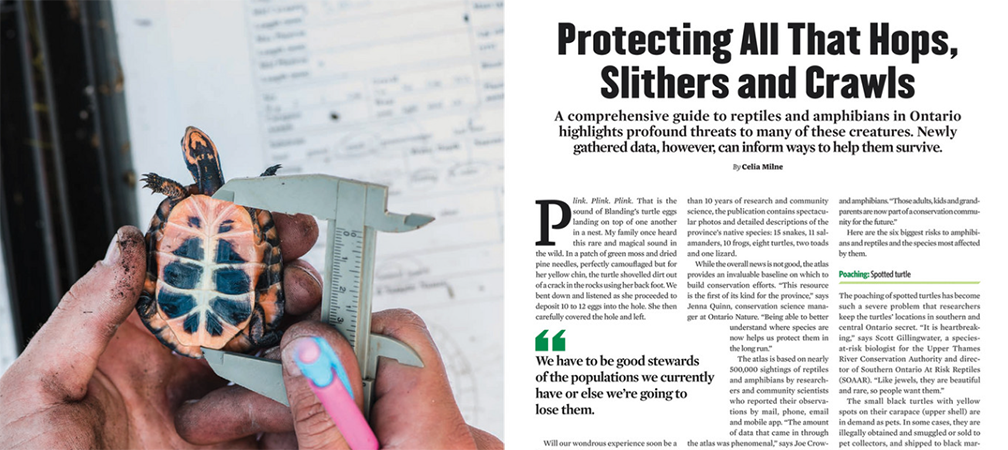
The familiar, high-pitched “peep peep” of the spring peeper is one of the first sounds of the season, a signal that plant and animal life is emerging from its winter dormancy. No fewer than 13 species of frogs and toads in Ontario can be heard calling from late March until August. Nearly 50 species of reptiles and amphibians inhabit our province, but, regrettably, one-third of Ontario’s amphibians and three-quarters of its reptiles are now designated as species at risk. Many reptiles native to Ontario are on the brink of local extinction. Read the full article…
Bridging over controversy
By Amber Cowie
Despite objections from Ontario Nature, local citizen groups and environmentalists, the Detroit River International Crossing (DRIC) project – a development that entails building a large addition to existing border facilities in both Ontario and Detroit and the construction of several roadways – is moving ahead. Naturalist groups have raised concerns about the DRIC, because it will destroy the habitat of eight endangered and threatened species that live in Windsor’s already heavily fragmented natural areas. Read the full article…
Ring of Fire heats up
By Jen Baker
Over the past two years, there has been a surge in the staking of mining claims throughout Ontario. This is particularly evident in an area known as the Ring of Fire, some 240 kilometres west of James Bay, where an unchecked explosion in staking and exploration activity threatens up to 1.5 million hectares of a globally significant landscape. Read the full article…
The fate of the fox
By John Hassell
The diminutive Arctic fox, easily distinguished from other fox species by its snow-white fur in winter, appears to be yet another casualty of the ecological changes brought on by global warming. The International Union for Conservation of Nature (IUCN) has identified the Arctic fox as one of 10 species that are highly vulnerable to changes in temperature arising from climate change, thus turning the spotlight on the animal’s few remaining refuges, which include northern Ontario. Read the full article…
Foreign bodies
By Douglas Hunter
Since their introduction in the 1960s to North America through fish farms and research facilities, Asian carp have become an environmental disaster. Having escaped Arkansas aquaculture farms, the invasive fish have established self-sustaining populations in the Mississippi River basin. Their northward migration reached a crisis point in late 2009, when Asian carp DNA was discovered in the Chicago Sanitary and Ship Canal, which links the Mississippi system with the Great Lakes. Read the full article…