
The weak spot
By John Lorinc
A respectable start, but not nearly enough to ensure that all the talk about smart growth becomes an urban reality.
Fall 2011

Animal farm
By Andrea McDowell
“Farming,” says Henry Bakker of Field Sparrow Farms, “is about good land management,” thus explaining his participation in Trent University’s innovative two-year research project on alternative approaches to hay harvesting that can help protect important bobolink habitat.
Wetlands in trouble
By Joshua Wise
Ontario Nature, working in partnership with the David Suzuki Foundation, Ecojustice, Ducks Unlimited Canada and Earthroots, are publishing two reports, one focused on the level of protection afforded fragile wetlands in the Greenbelt, the other on the rich diversity of species and ecosystems within the Greenbelt.
Ontario Nature’s Watch List
By John Hassell
Last June, the Ontario Ministry of Natural Resources released an updated version of its Species at Risk in Ontario List, and the numbers are disquieting. Forty-seven species are listed as being of special concern, 53 are threatened, 94 are endangered and 13 are locally extinct. Three species are of particular concern to Ontario Nature. The status of both the Jefferson salamander and Butler’s gartersnake changed from threatened to endangered. The cerulean warbler is now designated as threatened, whereas previously it was listed as being of special concern.
Ontario Nature’s fall birding hot spots
By John Hassell
You can learn a lot about the culture of an office by its internal memos. This past June, Ontario Nature’s executive director, Caroline Schultz circulated an all-staff memo alerting us that several chimney swifts – listed by the Committee on the Status of Endangered Wildlife in Canada as a threatened species – were flying above our building. At most workplaces, this announcement would not be a typical one. But at Ontario Nature, where birding is a common pastime about which many are passionate, no one was terribly surprised by it. Here, our most avid birders reveal their favourite fall birding spots, a surprising number of which are found either within or very near urban centres. Caroline’s pick? Along the south shore of Prince Edward County, near Belleville, which on average attracts a remarkable 220 bird species a year.
A native non-native
I have some reflections on Lorraine Johnson’s “Natural invaders” article on invasive non-native plants [Spring 2011, page 22].
It would be wonderful if nurseries in Ontario began to label native plants that are good for sustaining birds and other animals as “eco-friendly.” Education would be a necessary component, as gardeners would need to be convinced that holes in the leaves of their plants indicate not impending doom for the garden, but a thriving, healthy ecosystem.
Another reflection is that we need a nuanced approach to plants that may pose a threat to our ecosystems. We need to know which plants are the most detrimental so we can properly direct finite resources towards lessoning their impact.
A nuanced approach would probably find that black locust is not nearly as credible a threat as the other invasive plants featured in the article. The black locust is native to the eastern United States, as far north as Pennsylvania. But it has not arrived from offshore like the other invasive plants. So chances are black locust is fed upon by a full suite of native insects that in turn feed birds and other vertebrates. Consequently, it is probably far less damaging to the environment than plants that have arrived from Asia and Europe.
The tree proposed as an alternative to black locust – honey locust – also merits comment. Honey locust barely enters southern Ontario in the extreme southwest. Many parts of southern Ontario are geographically closer to the range of black locust than they are to [that of] honey locust. Is planting honey locust instead of black locust appropriate simply because its range squeaks into the political jurisdiction we call Ontario? In reality, is honey locust not as foreign to Toronto, Kingston and Ottawa as black locust?
Don Scallen, Georgetown, Ontario
Brake for bobolinks
While living in Glen Williams, Halton Hills, I was renting a house on a 60-hectare property that had two mating pairs of bobolinks. After reading your article on the bobolink online [Summer 2010, page 24], I joined Ontario Nature and have since purchased a membership for my granddaughter.
Armed with your article and others, I approached the farmer who leased the hayfields on our property and explained that if he cut our fields a bit later, the fledglings would have a chance to survive. He had about four large hayfields at the time, and he agreed to cut ours last.
My point is that we can all do our part, and cooperating made us both feel very gratified. I think your alliance with various farm groups will help, but we also need one-on-one contact with farmers to make them aware. Keep up the good work.
Bill Shepherd, Glen Williams, Ontario
Executive Director, OREA Centre for Leadership Development
Looking to the future
By Caroline Schultz
Over the course of Ontario Nature’s 80-year history, we have fought numerous battles for conservation. With you, we have witnessed many wins for the environment and also, regrettably, some losses. As the voice for nature in Ontario, we find ourselves preoccupied with the most immediate conservation battles of the day: fending off development to save significant habitat; crafting a rescue plan for an endangered species; pushing government to implement genuine protection for fragile ecosystems and at-risk wildlife; and, most challenging of all, forging solutions among disparate stakeholders that will, ultimately, reduce our ecological footprint on this province.
But our efforts are not undertaken at the expense of the big picture, a vision for the future of Ontario in which the natural wonders of this province are safeguarded and the needs of people and wildlife are met so that both can be sustained. Who will carry out this vision? Who will take on tomorrow’s environmental battles?
Our response is that one of the most important decisions we can make today is to cultivate an ethic of conservation in the next generation of environmentalists. This is why Ontario Nature created Nature Guardians, a program designed to raise environmental awareness and an appreciation for nature among young people. We know that when kids are given the opportunity to explore and connect with the natural world, their physical and mental health improves and school grades get better. We also know that the lack of such outdoor experience – a reality for many children – has been linked to childhood obesity, decreased attention spans and fewer coping mechanisms for stress.
Through our program, kids tell us how they are affected by the natural world and how they plan to confront the ecological challenges before us. For example, on the last day of Earth Month this year, five teens participating in the Nature Guardians program took action by organizing five simultaneous events planting trees, cleaning up shorelines and restoring trails. Afterwards, they posted comments and pictures on the Nature Guardians Facebook page, using social media to inspire and encourage their peers to follow suit. This is what youth leadership looks like.
At Ontario Nature we are handing the conservation torch to a culturally diverse and very passionate group of young people. Whatever career path they end up choosing in life, our best possible investment is giving kids experiences that will pay off in a powerful dedication to nature in the decades to come. As Anne Bell, our director of conservation and education, says, intimate contact with nature gives kids “moments that are filled with colours, sounds, smells, emotion, surprise, awe and wonder.”
In Denis Seguin’s cover article for this issue of ON Nature (page 28), he quotes one teen as saying that the Nature Guardians program has made her question the way she lives. It’s amazing, she adds, to see kids rising up and taking a stand. We, too, are amazed. If you share our awe for our young guardians, please support this program. Doing so will not only help with the day-to-day business of protecting wild species and spaces, it will also, amazingly, help realize the enormous potential in tomorrow’s environmental stewards.
Secret gardens
By John Lorinc
Green roofs are sprouting up in urban centres around the province, creating mini-ecosystems where you least expect them.
W hen Beth Ann Currie recently dug up the taproots of a cluster of coneflowers growing on the roof of an old industrial building in downtown Toronto, she realized this tall meadow species seemed to have an affinity for city living.The JAS Robertson Building, in Toronto’s garment district, was fitted with a 372-square-metre green roof in June 2004. Its owners, Urbanspace Property Group,wanted to create a natural meadow on a 20-centimetre-deep base of compost, using a wide array of indigenous species, including columbine, switchgrass, swamp milkweed and New England aster.
Although the seedlings were planted in large clusters, Currie, the environment, health and safety coordinator for Urbanspace, reports that not all the species took to the gusty environment. The coneflowers, however, adapted quickly. In ordinary soil, their roots go straight down. But the roots of those growing on the roof of the Robertson Building extended laterally and thus at a right angle to the prevailing northwest wind. “It’s a wonderful story,” says Currie. “Basically, they’re bracing themselves against the wind. The taproots aren’t going anywhere near the asphalt [beneath the compost], which debunks the myth that these plants dig holes in the roof.”
Over the last two years, green roofs have stormed onto the urban environmental agenda. Proponents say the green roofs —essentially green space on a rooftop — help reduce stormwater runoff, improve the energy efficiency of buildings by providing
better insulation, and counter the so-called heat island effect, the climatic anomaly that produces a column of warm air over large urban areas due to all the cars and heat-absorbing paved surfaces. In April, Green Roofs for Healthy Cities, a Toronto-based industry association, released a survey showing that the total area of installed green roofs across the United States and Canada increased by 72 percent between 2004 and 2005. U.S. cities such as Chicago and Washington, D.C., are leading the way, while in Ontario,Waterloo, Ottawa and Toronto have all taken steps in the past year to promote green roofs. Still, green roofs remain expensive and, in comparison to their presence in Europe, relatively rare. “The concept is basically in its infancy in North America,” says Bill DeLuca, president of Aldershot Landscape Contractors, the firm that installed the 10,684- square-metre green roof on the Canadian War Museum, which opened last year in Ottawa.
A significant challenge associated with installing green roofs is structural: the soil is heavy, so buildings with such facilities must be strong enough to support the load and be fitted with special roofing materials to protect against water or root damage.
But the biological issues are equally weighty. “The choice [of plants] is very limited because a green roof is a unique growing environment,” says Rick Buist, of Landsource Organix, the firm that worked on the Canadian War Museum and the Robertson Building, a joint venture with Gardens in the Sky, a Toronto-based company. Even two storeys up, the wind can be intense. Nor is it easy to predict what other species will blow in and take root alongside the plants put there intentionally.
Currie points out that many green roofs support only monocultures because the growing medium used is made of a porous mesh laced with a mineral mix. Urbanspace wanted biodiversity in its rooftop ecosystem, so the company chose a Swiss method that relies much more heavily on indigenous species and an organic growing medium.
In most of Europe, the growing medium is typically about 85 percent gravel and minerals, Buist told a recent gathering of the Ontario Association of Landscape Architects. His firm, in contrast, produces a growing medium made almost entirely of recycled and composted organics.“It’s natural,”says Currie,“not mined or quarried.”
Way of the Dodo
Ontario’s Endangered Species Act affords little protection for the species that need it most.
By Wendy Francis
One of the biggest environmental challenges facing us today is the alarming number of species that are eradicated from the planet every year. Habitat loss, excessive hunting and trapping, poaching, pollution and the impacts of climate change all contribute to this loss. In Ontario alone, there are 199 endangered species, a number that rises yearly as species fall victim to a variety of pressures. By the time a species is identified as being at risk of extinction, its numbers have dwindled to the point where the population is too small to produce sustainable future generations.
Ontario’s 199 species fall into the following categories: seven Extinct, 11 Extirpated, 81 Endangered, 47 Threatened, 55 Special Concern and eight others recently listed by the Committee on the Status of Endangered Wildlife in Canada (COSEWIC. Seven of these were designated as Special Concern and the eighth as Extinct.
The vast majority of the 199 endangered species in Ontario are or were found in the southernmost part of the province known as Carolinian Canada, where forests of indigenous walnut, hickory, oak and sycamore have been razed to make way for cropland, highways and cities. One species that depends on the native savannahs of Carolinian Canada is the northern bobwhite. The numbers of this small grassland bird have declined by nearly 88 percent in the province over the course of a single decade. Similar declines in northern bobwhite populations are occurring throughout much of its range in the United States. Causes of decline include the loss of grassland and meadow habitats, urban development, the removal of fencerows and brush, and pesticide use.
Effective endangered species legislation is critical to reversing these sorts of trends. Ontario’s outdated Endangered Species Act (ESA) of 1971,which Ontario Nature helped create, is no longer sufficient to do this job and is in need of a drastic overhaul.
For more than three-quarters of Ontario’s officially recognized species, the ESA fails to provide any protection whatsoever. This is due in large part to the fact that 158 of the 199 endangered species in Ontario —78 percent — are not covered by the ESA. It does not recognize the science- based lists of endangered species that COSEWIC or the Committee on the Status of Species at Risk in Ontario (COSSARO) produced. Rather, the provincial government establishes its own, limited list of species that receive the Act’s modest protection. Not surprisingly, for those endangered species for which trends are known, 76 percent are already extirpated from the province or are on their way out.
To stem this crisis of extinction, Ontario needs a new ESA that adequately protects all endangered species and ensures their recovery. Key elements must include mandatory protection for endangered species and their habitats, a sciencebased process for including species under the legislation, a requirement to prepare and implement recovery plans, adequate programs for species protection and recovery, and sufficient funding to support these activities. In February, Ontario Nature joined the Save Ontario’s Species coalition’s call for these changes to be implemented before the Fall 2007 provincial election.
Ontario committed to implement such measures when it signed, along with the other provinces and territories and the federal government, the National Accord for the Protection of Species at Risk in 1996.To date, however, it has failed to honour its commitments. Similar failure to live up to the national accord has recently led to legal action in British Columbia (over the endangered spotted owl) and in Alberta (over the threatened woodland caribou — a species also at risk in Ontario’s boreal forests).
Fortunately, in April, the provincial government introduced steps to initiate a review of the ESA. Natural Resources Minister David Ramsay has appointed an advisory panel to provide input into a discussion paper that will be used as a basis for public consultation in late spring. The panel members will also provide comments and perspectives on the information gathered through public consultation. Ontario Nature will be an active participant in this process to ensure that Ontario’s Endangered Species Act becomes a model for the rest of Canada.
There is much we can and must do to change our decisions and behaviours and reverse the factors that are pushing other species out of existence. If we can implement policies, plans, legislation and voluntary measures that protect the resources on which other species rely, we can stave off species decline. In the meantime, we should do our utmost to save those species that are teetering on the brink of extinction, by enacting a strong Endangered Species Act.
Wendy Francis is the former director of conservation and science for Ontario Nature.
Remembering Nelson Maher
Nelson (Nels) Maher, highly respected naturalist and dedicated outdoorsman, passed away on August 26, 2005, at the age of 71.
Maher never left Owen Sound where he was born. His many passions — photography, botany, camping, birdwatching and hiking — all involved the outdoors.
Maher was especially interested in ferns and became a self-taught expert on all of Ontario’s resident species. Recognized across Canada as an expert on rare and local ferns, he grew the plants from spores and maintained a spectacular fern garden at his home.
He was known as a community- minded person who always pitched in. Together with his wife, Jean, he led hundreds of tours to see local fern species and was a popular speaker. Among friends, he was held in high esteem as an expert brewer of elderberry wine, which he frequently shared.
Before his retirement, Maher was a self-employed printer and used his expertise to help the Owen Sound Field Naturalists publish several books on Ontario flora, specifically orchids, ferns and vascular plants local to Owen Sound — some of which are still used as textbooks in colleges across the province.
Maher’s photographs were featured in many of those books, but most prominently in Guide to the Ferns of Grey and Bruce County (1999). He used a reverse-photography technique in which he exposed his ferns on photographic paper and then printed them in black on white backgrounds, producing prints that revealed the intricate detail of each photographed species.
Maher continued to lead tours long after he retired from the printing business and conducted fieldwork for the Ministry of Natural Resources when he was in his seventies. He hiked through forests to document rare species of ferns and orchids that were then catalogued in databases at the Natural Heritage Information Centre in Peterborough.
Maher also served as a volunteer with Scouts Canada, the Owen Sound Rotary Club, the National Park Advisory Board for Bruce National Park and Owen Sound’s Communities in Bloom project, and was a lifetime member of the Owen Sound Field Naturalists.
He is survived by his wife and six children and is missed by many others.
Curious About Conservation?
If you are interested in learning about Ontario’s globally rare habitats and what you can do to help protect them, join Volunteer for Nature (VfN) for an up close out-of-doors volunteer experience. Ontario Nature and the Nature Conservancy of Canada (NCC)’s successful conservation volunteering program is a great way to get involved in hands-on conservation projects.
VfN volunteers lend a hand with practical projects designed to help preserve some of Ontario’s best natural areas. As part of the program, you can polish up your plant identification skills at Stone Road Alvar on Pelee Island or conduct bird inventories on Manitoulin Island, help minimize ecological footprints at Petrel Point Nature Reserve by building a boardwalk to protect a wetland or monitor forests at Altberg Wildlife Sanctuary in the heart of Kawartha Lakes. All of these projects are important contributions to the long-term stewardship and protection of Ontario’s natural heritage.
Since 2002, thousands of Ontarians have contributed to more than 130 VfN conservation projects, including 75 projects to help species at risk and more than 50 that reduced impacts and restored important places such as Temagami, Lake Superior Provincial Park and the Rice Lake Plains.With assistance from the J.W. McConnell Family Foundation, the VfN program will be bringing great adventures and learning opportunities to Ontarians for the next four years. Beginning in 2007, Albertans will also be able to experience conservation volunteering as the VfN program moves west.
Bred in the bone
Drawing from his Ugandan heritage, Yuga Juma Onziga, founder of the Environmental Centre for New Canadians, has created a global village in the heart of a big city
By Allan Britnell
Located on the ground floor of a decidedly unfashionable city works department building in Toronto’s downtown Fashion District, the Environmental Centre for New Canadians (ECENECA) is a barebones, L-shaped office crowded with second-hand desks and shelves piled high with environmental books and brochures. On the walls are photos of past ECENECA events and images of founder Yuga Juma Onziga’s native Uganda.
Recent immigrants from all corners of the globe —Africans, Asians, South Americans— trickle in and out to fax resumés, practise their keyboarding skills or simply pick up a copy of the public transit route map Onziga, a stocky, kindly man with a measured manner of speech, established ECENECA in 1993 to help newly arrived immigrants understand that the environment can affect their health and quality of life, and to involve them in conservation activities. Along with ECENECA’s mandate to “deliver environmental education to assist new immigrants to adapt to Canadian culture pertaining to environmental issues,” Onziga says he also provides “empathy and general advice on coping with differences, like the weather.” His organization’s efforts earned it the 2005 Canadian Environment Awards (CEA) gold medal for Environmental Health.
Yuga Juma Onziga’s Canadian home is worlds away from where he grew up. The environmentalist was raised in Kobuku, the northwestern region of Uganda that borders on Congo and Sudan. His people, the Kakwa (pronounced “kah-qua”) live in grass-roofed huts that sit on plots of land where they grow their own food.Today, he resides in a high-rise apartment in Toronto’s St. Jamestown, one of the most densely populated neighbourhoods in North America.
Of course, both communities are on the same planet and, in our increasingly shrinking global village, the environmental issues in one area can (and will) eventually affect another. But Onziga knows from first-hand experience that many new immigrants may not have the luxury of worrying about ecological problems. “They are not thinking much about their health and the environment,” he says, “because they are too worried about their economic survival.”
“People from other cultures coming to Canada should be aware of our environmental problems and encouraged to participate,” says Paula Prociuk, managing director of the CEA. “We were very impressed with the leadership that Yuga Juma displayed, and we felt that he could be a good example to new Canadians as to how they can be involved in the issues.” Onziga’s story begins in an all-too common way in war-ravaged, post-colonial Africa. His pursuit of a forestry degree was interrupted by civil war in Uganda, and he was forced to flee with his wife and two-week-old daughter when rebels deposed infamous dictator Idi Amin in 1979. (Amin’s father was Kakwa, and the minority Kakwa population in Uganda were “marked for revenge,” says Onziga.)
His family fled to Congo and then Sudan. Finally, in January of 1984, they immigrated to Canada, arriving in Toronto knowing no one in the snow-covered city. “It was like going from an oven to a freezer.”
With an incomplete degree and limited job prospects, Onziga enrolled in the agriculture program at the University of Guelph, where he studied environmental sciences, graduating with an honours degree in 1990.
His interest in nature is, however, more than purely academic. The Kakwa people have a very tactile connection to their environment. As subsistence farmers, they know that an entire season of labour-intensive work can be wiped out by locusts or drought. They also have a deeply ingrained sense of conservation. The Kakwa trace their lineage to a man named Yeki, who migrated from the east and settled on Mount Liru sometime around the 1700s. As the place where all Kakwa originate,Mount Liru is a sacred site.
“That’s where our idea of protecting the environment comes from,” says Onziga. “The trees, mushrooms, honey, even firewood . . . everything is protected. Every aspect of life [on Mount Liru] is respected.”
After finishing his degree, Onziga moved back to Toronto, where he worked with the South Riverdale Community Health Centre to raise awareness among recent immigrants of the potential impact indoor air pollution can have on their health. His work on that project and the connections he made inspired him to launch ECENECA.
Since its founding, the all-volunteer organization has held countless workshops and seminars, produced and translated brochures about environmental programs — such as the Guide to Environmental Education for New Canadians and a multilingual indoor air-pollution quiz — and regularly takes groups of immigrants on organized nature walks to familiarize them with the ecosystems they live in.
ECENECA’s volunteers are also willing to get their hands dirty for a good cause. As many as 75 people at a time have participated in ECENECA tree plantings or outings to clean up garbage in the Don River Valley, the latter often being an eye-opening experience. “I can’t believe what we’ve removed,” says Onziga. “Pop cans, tires, motorcycles…”
He believes that projects like the restoration work in the Don are particularly important for immigrants to see and be involved in as doing so can inspire hope that seemingly irreparable watersheds in their homeland—be it the Nile,
Ganges or Yangtze — can also be brought back to life. Onziga expands on that knowledge base by informing participants of the need for energy conservation and the benefits of alternative energy, and by trying to build an “awareness that toxic substances, like DDT, that are banned here can be found in their home countries where they have a detrimental effect on their health and the environment.” His hope is that the lessons learned here will be shared with the developing world. “Whenever they go home they can take not only material things, but also knowledge and an environmental consciousness.”
But ECENECA’s main focus is on the role immigrants can play in their new home. For starters, many aspects of conservation that long-time Canadians now take for granted, such as our curbside blue box program, are mysterious and new to immigrants.
“We recycle everything here in Canada,” says Nelson Rojas, a long-time ECENECA volunteer who emigrated from Bolivia. In most countries though, recycling programs are non-existent so “it’s a surprise to many that plastics can be melt[ed] to produce more plastics.”
Treasure islands
Wild spaces, like Ontario Nature’s reserves, are rich in plants, animals and history.
By Peter Middleton
Illustration by Gracia Lam
Last June at Ontario Nature’s annual general meeting, I joined a field trip on which our guides led us through a rare remnant of prairie and black-oak savannah habitat on a lovely stretch of the Oak Ridges Moraine. We walked through an area belonging to Alderville First Nation, where 50 hectares of rolling prairie grassland and oak savannah, once threatened by housing development and aggregate extraction, are now protected. Today, the landscape blooms with prairie buttercup, wild lupine and butterflyweed. In the distance, we could see the silhouette of the fire-resistant black oaks. In the past, this land supported herds of deer and elk, and the First Nations peoples who hunted them.
Our guides brought us to the tall-grass prairie reserve of Red Cloud Cemetery. This site, designated as a cemetery in 1850, has never been ploughed. In 1992, Dr. Paul Catling, a plant taxonomist, declared the cemetery to be a remnant prairie because of the presence of a number of prairie grasses and forbs within its boundaries.
At the cemetery, Elwood, a 92-year-old member of the Red Cloud Cemetery board of directors, welcomed our group. This plot of virgin prairie is truly a stunning place to walk through, especially when one is aware that its soils and plants have survived, relatively unchanged, since the glaciers withdrew some 10,000 years ago.
As I looked around in wonder, Elwood drew me aside. He told me of his family and his poor but happy childhood, and of his love for the tiny patch of land we stood on and the profound meaning its preservation had for him. With reverence he talked about the link between humanity and landscapes, and about the people who had occupied this land over time and how the land had nurtured them. He pointed out the importance of conservation, not only as it applies to plants and ecosystems, but also as a way of recognizing that such remnants are links with a planet that has supported countless generations of humanity. He did not refer to land as property, but rather as a source of support. “The land fed me, nourished me and will reclaim me. I ask no more than that. It has done that for people from the beginning. It is where I belong.”
Reflecting on his words, I thought about Ontario Nature’s nature reserves system and its importance both for Ontario as a whole and for me personally. The reserves contain the timeless threads of creation in their fabric. Their preservation represents a priceless heritage set aside for the province by Ontario Nature.
Ontario Nature (formerly the Federation of Ontario Naturalists) acquired its first reserve, Dorcas Bay (also called Singing Sands) in 1961. Located on the Bruce Peninsula, this place has special significance for me, and I visit often. The coastal alvars and forests of the region, although greatly reduced by recreation-related development, contain jewels of global importance found in few other places on the planet: bird’s-eye primrose, ram’s-head lady’s slipper and massasauga rattlesnake. Every time I visit, I am reminded of the beauty, tenacity and continuity of life.
The shorelines of the Bruce Peninsula support unique ecosystems. The steep cliffs on the eastern shore of the escarpment and on the sloping limestone plates on the west supported an amazing array of plants. Until late in the 20th century, our presence was evident mostly in the occasional fishing or hunting camp. This changed, however, as southern Ontario’s population grew and more cars filled more roads, and people’s leisure time and recreational interests increased. Dorcas Bay is a reminder of what this area used to be. Having visited the reserve so frequently, I know it intimately – it has shaped my philosophy as a naturalist and outdoor educator.
Each Ontario Nature reserve is a “Rosetta stone” that will allow future generations to connect with a distant past and to witness the tapestry of evolution. The conservation of such places is of the utmost importance, for the heritage, both natural and human, that they hold. These are both islands of refuge and, in a way, islands in time.
Peter Middleton is a lifelong member of Ontario Nature and president of the Owen Sound Field Naturalists. He has taught and administered outdoor education programs for the Bruce County Board of Education and the Bluewater District School Board.
Congratulations to our Conservation Award Winners
Ontario Nature celebrated 80 years of protecting wild species and wild spaces at our annual general meeting last June. One of the highlights of our gathering at the Ganaraska Forest Centre on the Oak Ridges Moraine was presenting our conservation awards to eight individuals and groups that have made exceptional contributions to natural habitat protection.
This year’s conservation heroes tell us about their vision for a greener Ontario:
Jim Johnston, recipient of the Ontario Nature Achievement Award, spearheaded the development of the Elliot Lake Bear Smart Project from 2003 to 2004, which subsequently became the Ministry of Natural Resource’s Bear Wise Program. “Before that program, people didn’t have to put their garbage in sealed containers outside, they had it in bags,” says Johnston. “We improved the management practices at the local waste dump and converted all the containers in our parks to bear-proof ones.” Thanks to Johnston’s program, nuisance calls about bears in the Elliot Lake area decreased from some 530 calls in 2004 to less than half that in 2010.
Jane and Fred Schneider were awarded the W.W.H. Gunn Conservation Award for their outstanding service and commitment to nature conservation. For more than three decades, the couple has welcomed visitors to their 300-hectare rural property outside Waterloo, which contains provincially significant swamps, woodlands and fields. “We’re trying to preserve the old forest and keep the trees healthy,” says Jane. The couple has been impressed with the absence of litter in the area despite the high volume of visitors, demonstrating that the “the younger generation is taking good care of the property.”
Christine Hanrahan received the W.E. Saunders Natural History Award for her efforts to protect Larose Forest and her work on the Ontario Breeding Bird Atlas. Hanrahan and others hold an annual community day to introduce people to the forest, and every two years she oversees the organization of a forest bioblitz, using the resulting data to inform best practices for managing the Larose Forest. “As it’s a working forest, this data is used by various organizations to see where the birds are and accordingly decide where not to log,” says
Hanrahan.
The Steve Hounsell Greenway Award recipients – Iris McGee, Renee Sandelowsky and Allan Elgar – founded the Oakvillegreen Conservation Association more than 10 years ago in response to a proposal to urbanize 3,000 hectares of agricultural land in north Oakville. For McGee it has been quite a ride: “Taking that first step to attend a council meeting or write a letter to your local newspaper or councillor can set you on a journey toward making positive change.” She believes that forests, fields and streams should be protected through proper zoning so that taxpayers do not have to buy land to protect it.
The Fatal Light Awareness Program (FLAP), established in 1993 by Michael Mesure and a team of volunteers, won the J.R. Dymond Public Service Award for the group’s efforts to provide safe passage for migratory songbirds in the urban environment. Annually, between one and 10 birds will die in collisions with any single building. With 940,000 registered structures in Toronto, a conservative estimate would be that between approximately one and 10 million birds die annually. “This is a David and Goliath story, but the simplicity of the solution really resonates with people,” says Mesure. “It could be easily resolved with the flip of a switch at night and placing some markers on the glass during the day.”
The Lee Symmes Municipal Award was awarded to the County of Northumberland for its comprehensive forest management plan for a 2,200-hectare forest on the Oak Ridges Moraine. By expanding a network of wooded conservation areas, the county supported a management approach guided by the spirit and intent of the Oak Ridges Moraine Conservation Act and corresponding plan. Says Mia Frankl, the county’s forestry management officer, “We hope to lead by example among municipal governments in preserving natural spaces and managing them first and foremost for their ecological significance, while still providing balanced use for social and economic values.”
The Huron Perth Healthcare Alliance received the Ontario Nature Corporate Award for its efforts to reduce its ecological footprint. Chief executive officer Andrew Williams realizes that, while the primary goal is to deliver health care, the alliance also feels responsible for making the workplace more environmentally friendly. “We look at this as part of our commitment to the broader community and see a logical connection here, as a healthy environment is closely tied to healthy people,” says Williams. The alliance has launched a number of energy conservation efforts at its four sites, including retrofitting lighting throughout the facilities, lowering energy use during times of peak demand and partnering with other organizations in progressive energy conservation programs.
Fraser Gibson won the Richards Education Award for fostering environmental values and actions in children throughout his career teaching outdoor and environmental education. Now retired, he continues to promote the importance of the natural world. “My overriding objective is to promote, in children and adults, respect for all life and habitat. Guided exploration of natural areas is a very important first step.”
The big pit
When The Highland Companies announced plans to build one of North America’s largest quarries on some of the richest soil in southern Ontario, farmers, citizens and local politicians dug in for a fight. In the court of public opinion, the quarry-busters seem to be winning.
By Cecily Ross
Norman Wolfson, a Toronto businessman, and his artist wife, Sandi Wong, spend most weekends at a windswept retreat they built seven years ago high on a ridge in Dufferin County. The home overlooks the rolling lushness of the Niagara Escarpment to the east and Melancthon Township’s vast counterpane of potato lands to the west. Wolfson well remembers the day a few years ago when a neighbouring farmer dropped by and told him that someone was buying up all the farms in the area. Somewhat apologetically, the farmer admitted that he, too, had sold. He got an offer he couldn’t refuse. “But,” he told Wolfson, “I realize now that they’re not just after potatoes.”
“He had tears in his eyes,” Wolfson recalls.
That farmer was turning his back on no ordinary farm. His land and the surrounding farms have some of the best growing soil in eastern Canada. Honeywood loam is named for a tiny hamlet in north Dufferin County just up the road from Wolfson’s place. According to the North Dufferin Agriculture and Community Taskforce half of all fresh potatoes consumed in the Greater Toronto Area are grown here in Melancthon Township, which lies at the highest elevation in southern Ontario. The rich soil also produces an abundance of cereal grains, hay and pasture. No wonder The Highland Companies, a Nova Scotia corporation operating in Melancthon, wanted to acquire some of this land in its stated quest to become the largest potato producer in Ontario.
In 2006, Highland began purchasing land in the area, offering farmers $8,000 an acre, at least a 30 percent premium on the market value. The company eventually amassed about 7,500 acres (2,630 hectares) in Melancthon and Mulmur townships. But Wolfson’s neighbour was right. It seems something is even more valuable than Honeywood loam up here, and that’s Amabel dolostone limestone. Underneath all that rich vegetable-growing soil lies one of the largest deposits of the highest-quality limestone in the province.
Highland is backed by a Boston-based hedge fund called the Baupost Group. On March 4, 2011, Highland filed a 3,100-page application with the Ministry of Natural Resources to develop 2,135 acres (937 hectares) of agricultural land for aggregate extraction. But this is to be no ordinary gravel pit. The magnitude of the proposed Melancthon quarry is staggering. The hole in the ground will be anywhere from 27 to 77 metres deep – which is one and a half times as deep as Niagara Falls – and well below the water table. The pit will span an area more than three times the size of the Toronto Islands. The quarry may have an impact on the headwaters and watersheds of five rivers: the Nottawasaga, the Saugeen, the Humber, the Credit and the Grand.
What’s more, the pit will lie on the western edge of the Niagara Escarpment, a UNESCO Biosphere Reserve inhabited by hundreds of species of flora and fauna. Indeed, thanks to ongoing development in southern Ontario, 40 percent of Ontario’s rare flora along with numerous at-risk species are preserved on the escarpment.
To mine the limestone, the company will have to pump 600 million litres of water out of the pit every day. That water will then be pumped back into the ground to resume its journey into the surrounding streams, rivers and wells. When the quarry is operating at its full potential, more than 150 trucks could be leaving and entering the area every hour of the day, with the attendant dust and noise.
The story is as old as that of David and Goliath: a small community of farmers and local politicians with no money pitted against a big, foreign-owned company with vast resources. What has ensued so far is a war of words and statistics, with one side raising the spectre of unrelieved environmental and social disaster, while the other paints a picture of prosperity, harmony with nature, and the joys of sustainable progress – a picture that most people up here just don’t buy.
On the day I visit Wolfson and Wong, we stand beside their beautiful home and look out over the ploughed fields spreading away to the west. In the far distance, I can make out a stand of wind turbines. Despite the controversy the towers have been generating over the past few years, they are beginning to look insignificant – small potatoes, in retrospect. Because, if things go according to Highland’s plans, in a few years the couple’s view will be obliterated by a mega-quarry, one of the largest in North America, belching clouds of dust into the sky, six days a week.
“We won’t be able to live here,” says Wong. “This was going to be our retirement. Now it’s mega-death.”
The politics of pits
Aggregates are a vital resource in construction-hungry Ontario, a province that has grown to accommodate more than 13 million people. The provincial Aggregate Resources Act reflects this reality by allowing quarry developers to bypass comprehensive environmental assessment requirements.
And yet every time a company applies for a quarry licence, opposition from environmentalists and nearby communities is swift and vociferous. Right now, battles like the one escalating in Melancthon Township are playing out across the province, costing the industry, municipalities and private citizens untold millions of dollars.
Kevin Thomason, on Ontario Nature board member, is a high-tech executive in Waterloo who describes himself as “a passionate advocate” for the environment. He believes that the regulations aren’t keeping up with construction activity. “At one time,” he says, “roads were paved once every 10 years and trucks could only carry a few tonnes. It was inconceivable to move gravel more than a few miles. Now,” he continues, “entire communities are decrying the loss of farmland, the dust and truck traffic. We need rules and regulations that cover the current realities.”
The David Suzuki Foundation’s John Werring agrees. “The system is ass-backwards,” he says. “The government should require the [quarry] applicant to go to the community before spending millions of dollars doing ‘comprehensive’ studies.” When bureaucrats tell a company to go ahead with environmental studies for a project on which it then spends millions of dollars, “the government has given the company the idea that the project is going to be approved,” says Werring. “All of this happens before the community has a chance to be involved.” Arguably, a quarry of this magnitude would never have come this close to realization had Highland been required to begin at the municipal level.
Thomason would like to see 150 small, sustainable quarries across the province instead of large operators coming in under false pretences. “In too many cases, these projects are sited in small communities with people who don’t have the knowledge to fight back, while the company has unlimited resources,” he says.
But even as the fight in Melancthon grinds on, there is hope that future quarries may follow a different process. On June 1, Ontario Nature and five other environmental nongovernmental organizations, along with the Ontario Stone, Sand and Gravel Association, collectively known as the Aggregate Forum, announced the development of a certification program that will enhance standards of environmental stewardship and community engagement across Ontario’s aggregate industry.
Caroline Schultz, executive director of Ontario Nature, says, “We feel that it is critical for us to put in place a program that has the involvement and support of a broad group that reflects the consensus of a wide constituency of environmental, community, industry, and provincial and municipal interests. It is essential to have a process that communities can trust.”
The quarry effect
In Highland Companies’ application for a licence to operate a limestone quarry in Melancthon Township, Edmonton-based Stantec Consulting Ltd. reported its assessment of the potential impact of the pit on species in the region. Of particular concern to environmentalists are the bobolink and the Henslow’s sparrow – two species at risk known to nest in the area – as well as fish habitat, namely that of brook and rainbow trout in the Pine River.
John Werring, with the David Suzuki Foundation, reviewed Highland’s 3,100-page application in a 10-page letter to the Ministry of Natural Resources last spring. He concluded that the consultants’ report did not contain enough data to support their findings.
For instance, the consultants stated that bobolinks were observed in the area of the proposed pit, but contended that the numbers were “relatively low.” Werring counters that “all the consultants reported was that bobolinks were found ‘where appropriate habitat occurred.’ They do not quantify how much bobolink habitat is in the licensed area.” And, according to Jon McCracken, a biologist with Bird Studies Canada, “if the pit destroys grassland habitat, then that’s against the Endangered Species Act.”
Anne Bell, director of conservation and education for Ontario Nature, adds that the Endangered Species Act requires the developer to “agree to a set of conditions whereby, in the end, the species in question will be better off than before the development took place.”
The Highland consultants found no evidence of Henslow’s sparrows, Werring reports, but he’s dubious about the methodology used to search for the bird. “All the consultant did was to go into the field on two separate days in June of 2008 and broadcast a recorded song for, at most, six minutes at a few locations. Needless to say, they did not find any of these birds during these brief surveys.”
The consultants also asserted that the quarry would have no negative impact on fish habitat, says Werring. In fact, they concluded that the proposed mega-quarry would improve “the diversity, connectivity and function of the natural heritage systems in the area.”
“We question how these conclusions can be reached,” Werring wrote in his letter to the ministry. “The salient points I raised in my letter,” Werring explains, “are that they haven’t done a good enough job of identifying the fish habitat. The project should be subjected to a detailed environmental review.”
Emil Frind, a professor of earth sciences at the University of Waterloo, whose specialty is groundwater, is likewise sceptical. “Highland says there will be no effect on groundwater, and I think that is not true. They have no basis for claiming that. The water quality is not going to be the same; it’s going to be much worse.”
Cecily Ross
The scent of a turtle
Scientists turn to man`s best friend to help in recovery efforts for one of our most endangered reptiles.
Text and Photography by Conor Mihell
Charging along a frenetic course through a cedar swamp, Rebel looks like any youthful Labrador retriever exploring the outdoors. Nose to soggy ground, he zigzags haphazardly through tangled alders at a pace no human could match. Rebel’s handler, Ontario Ministry of Natural Resources (MNR) conservation officer Mike Buckner, seems exasperated by his dog’s hyperactivity. “He always wants to be at the front of the pack,” sighs Buckner, who has been training MNR “canine units” for 12 years and is currently serving as the acting supervisor of provincial canine services.
Branches slap my face, mud grabs at my feet and mosquitoes chase in my wake as I follow Rebel and Buckner, as well as MNR species-at-risk biologists Nathan Hanes and Jessica Sicoly, through the wetland. With great relief, we emerge onto a sandy beach on a river north of Sault Ste. Marie, where Hanes and Sicoly are conducting a field survey in search of wood turtles, a species listed as endangered under the provincial Endangered Species Act (ESA). (Due to the risk of wood turtle collection for the illegal pet trade, MNR does not disclose the precise locations of this turtle.) With his sharp nose and go-anywhere enthusiasm, two-year-old Rebel – who is trained to Ontario Provincial Police dog standards and capable of detecting a dozen different scents – is the team’s turtle-sniffing secret weapon.
Ontario is home to an estimated 1,100 wood turtles, or about 8 percent of the North American population, which ranges from Ontario to Nova Scotia, throughout the Great Lakes states and as far south as Virginia. Joe Crowley, a Peterborough-based MNR herpetology species-at-risk specialist, says the distribution and abundance of wood turtles on the Canadian Shield of central Ontario, at the northern and western edges of the species’ range in Ontario, “has probably remained relatively consistent with pre-settlement conditions.” However, habitat loss due to agriculture and development, road mortality and pressure from poachers have all but wiped out wood turtles from their historical southern Ontario range, and forestry and off-road vehicles are probably curtailing northern populations as well.
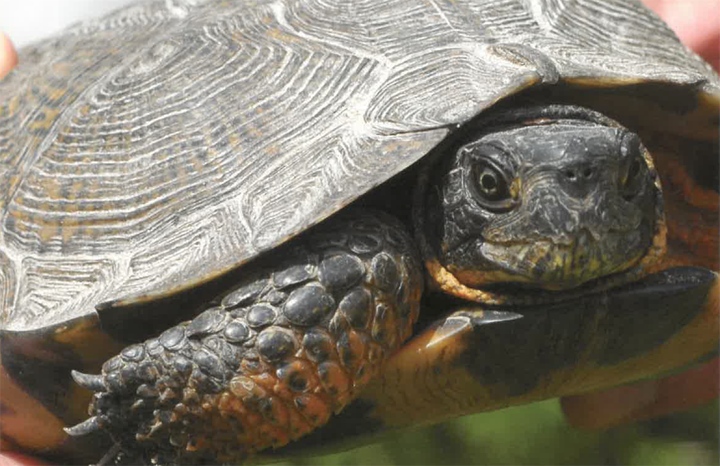
As I pause to catch my breath after completing the bushwhack, Rebel’s efficiency leaves me dumbfounded. In the time it takes five humans to merely spot the wispy marks left by a wood turtle in the sand, Rebel has found the source of the tracks – a dessert-plate-sized turtle with orange appendages, a tiger-tail-patterned underside and a gnarled, wood-like shell that camouflages it perfectly in a bramble of dogwood and ferns. Rebel perks up his ears, wags his tail rapidly and sits, proud of his find and quivering with excitement. As a reward, Buckner flips him a rubber ball, and Rebel lies down for a satisfying chew.
It’s late May, and in the next few weeks this female wood turtle (its gender identifiable by its flat lower shell, or plastron) will likely lay a clutch of up to 18 eggs on a beach like this one. She has probably just wandered away from the water to warm herself in the morning sun, Hanes tells us, as he records air and water temperature readings. Wood turtles spend more time on land than any other of Ontario’s eight species of turtle. Since turtles rely on their external environment to regulate their body temperature, in all likelihood this one spent the cool overnight hours in the relatively warm river water. The species also spends the winter months in rivers or streams under the ice. (Turtles, like frogs, snakes, lizards and salamanders are “ectotherms,” meaning that their surroundings control their body temperature.)
Wood turtles don’t mature until well into their teens and have a very low reproductive success rate due to flooding of nest sites, parasites, infertility, and predation by raccoons, foxes and skunks, which eat turtle eggs. “A female may only produce a couple of offspring over the course of her life that survive to adulthood,” explains Crowley, who previously coordinated the Ontario Reptile and Amphibian Atlas project for Ontario Nature. But since adult wood turtles have few natural predators, they can live upwards of 50 years – enough time to maintain stable populations. This is why the species has persisted since the dinosaur age. But now its continued survival is threatened – by us.
How you can help turtles
The fact that the Ontario Reptile and Amphibian Atlas has added more than 160,000 records, many provided by the public, to provincial natural heritage databases in just two years demonstrates volunteers’ ability to play a key role in conservation.
Ontario Nature staff ecologist John Urquhart says the biggest contribution the public can make is to document and report sightings of species such as turtles, salamanders and frogs. Under Ontario’s Endangered Species Act, simple observations identifying species and their location (preferably including photos and a site description) “automatically create the potential to protect their habitat,” says Urquhart.
Rural property owners can go further by being good stewards of their land. Maintaining buffers around watercourses protects water quality and preserves important transitional habitat, making it a valuable ecological practice for conserving populations of reptiles, amphibians and other species of wildlife.
For more information, visit these websites:
Ontario’s Reptile and Amphibian Atlas: www.ontarionature.org/atlas
Adopt-A-Pond: www.torontozoo.com/adoptapond
Ontario Turtle Tally: www.torontozoo.com/adoptapond/turtletally.asp
Conservation Ontario: www.conservation-ontario.on.ca
Ontario’s Species at Risk Program: www.mnr.gov.on.ca/en/business/species/index.html
Conor Mihell
The Ottawa Valley in autumn
A guided tour of nine great nature getaways in eastern Ontario.
By Caroline Schultz & Mark Stabb
Eastern Ontario naturalists sometimes jokingly refer to the phenomenon of the “Kingston curtain” – a perceived boundary in the knowledge and experiences of southern Ontario nature lovers about the landscape east of Kingston. During almost a decade of living and working in the Ottawa Valley, we both observed this anomaly. We know “the Valley” as a distinct cultural community that retains a link to the great river that shaped its history. Defined by its drainage through tributaries such as the Petawawa, Bonnechere, Madawaska, Mississippi and Rideau, the Ottawa Valley is rich in unheralded natural areas. Now that we have moved from the region, we miss our natural history explorations in this beautiful part of the province – the big, clean waters, the wild areas and the hidden gems that spice up the landscape.
Most of these spots have strong river connections. Like the Nile, the Ottawa River flows through a gargantuan trench caused by bedrock displacement. The area has a high concentration of fault lines and the earthquakes that come with them. The geological activity created a huge linear depression known as the Ottawa-Bonnechere graben. Hills and cliffs climb steeply along the sides. Downstream, clay deposits mark the site of the postglacial Champlain Sea.
The mighty Ottawa, which drains an area twice the size of New Brunswick (around 146,000 square kilometres), still has wild shorelines and roaring whitewater. But the 1,300-kilometrelong river is much diminished from what it once was, not least because of the 50 or so dams that interrupt its flow. Some 8,000 to 10,000 years ago, the river carried most of the waters of the Great Lakes and carved evidence of its force in the bedrock. The channels of this ancient waterway swerve away from the existing riverbed and have developed into large wetlands.
Spectacular and special sites line the Ottawa River and its tributaries. We encourage you to explore some of our favourite spots, places we love to return to.
Mer Bleue and Alfred bogs
Two of eastern Ontario’s best-known wetlands – Mer Bleue Bog and Alfred Bog – were formed in ancient, low-lying former channels of the Ottawa River. While most bogs in southern Ontario have been drained or mined for peat, groups of committed conservationists have seen to it that large portions of these two bogs are protected and, with the aid of boardwalks and interpretive signs, accessible to visitors. In the fall, you can find these wetlands aglow with the rich reds and auburns of heath vegetation.
Mer Bleue Conservation Area protects a 2,500-hectare raised peat bog, located within the Ottawa Greenbelt. The site was expropriated in the 1940s by the Department of National Defence (DND) to serve as a bombing range. DND ownership allowed Mer Bleue to escape development amid the rapidly urbanizing landscape, and it is now one of the most studied bogs in the country, recognized as a wetland ecosystem of international significance under the Ramsar Convention.
A walk along the 1.5-kilometre boardwalk will give you a true taste of northern flora, with sightings of black spruce, tamarack, bog rosemary, Labrador tea, blueberry and cottongrass. Orchids, as well as insect-eating pitcher plants and sundew, are also common. Birding is a popular activity here during spring and fall migrations, and in the summer you can get glimpses of such breeding birds as Lincoln’s sparrow, clay-colored sparrow and palm warbler.
Protecting Alfred Bog required a greater effort. For 30 years, the bog was actively mined for peat, after a struggle by the Ottawa Field-Naturalists’ Club (OFNC) and the Vankleek Hill and District Nature Society (VHDNS) failed to prevent a zoning change that allowed peat extraction to proceed. Today, thanks to dedicated collaboration between the OFNC, the VHDNS, the Nature Conservancy of Canada, the South Nation River Conservation Authority and the United Counties of Prescott-Russell, 90 percent of the remaining bog is permanently protected. The raised peat bog has been building for 10,000 years and harbours many rare or endangered plants and animals, including the bog elfin butterfly, Fletcher’s dragonfly, eastern white-fringed orchid and rhodora. Northern birds such as the gray jay and black-backed and three-toed woodpeckers have been spotted there.
At 4,200 hectares, the Alfred Bog is the largest peatland in southern Ontario and the pride of Alfred and Plantagenet Township. “Rarely do you go there when there isn’t someone visiting the boardwalk,” says Frank Pope, OFNC member and chair of the Alfred Bog Committee, which oversees the bog’s protection. “It gives a super view of the heath portion of the bog.” With a nature reserve at its core, the bog adds wildness to an otherwise tame agricultural landscape. Moose still inhabit the area, which is outside the species’ typical range. Alfred Bog is well worth a visit, though it’s a bit more out of the way than Mer Bleue and the boardwalk is more rustic.
Mer Bleue
613-239-5000
info@ncc-ccn.ca
www.ontariotrails.on.ca/trails-a-z/mer-bleue-conservation-area-mer-bleue-trail/
Alfred Bogs
1-877-984-2984
info@nation.on.ca
www.ontariotrails.on.ca/trails-a-z/alfred-bog-walk-trail/
www.ofnc.ca/conservation/alfredbog/index.php
Madawaska Highlands trails
In the rugged and wild forested hills of the Madawaska Highlands, undeveloped Crown land eclipses private holdings, and logging, hunting, trapping and fishing continue on the public lands. But over the past decade, some new opportunities have opened up for nature lovers to explore the public properties in this land of marble and granite. For people who crave the self-propelled challenge of backcountry wilderness exploration, the Madawaska Highlands offer a number of ways to become immersed in the region’s natural history. At Calabogie Lake, local resort owners and municipal authorities have opened a series of loop trails that lead to wonderful vistas of the hills. Eagle’s Nest Trail and Manitou Mountain Trail are two well marked and well used paths through highland habitats.
But perhaps the best introduction to this area is the Griffith Uplands trail. Opened in 2010 (with assistance from the Greater Madawaska Township), it offers a two- to three-hour walk that takes you first through a young forest and then across a clear creek, where trail creator Tim Yearington has left a water cup to tempt thirsty hikers. Here, you can actually hear the water running underground through the fractured rock. Then the ascent starts. You climb past some mature stands of pine and oak before the forest begins to open up to barren rock, with shrubs and stunted trees along the hilltops. In summer, you may see blueberries in profusion and woodland sunflower. The trail even skirts some wetlands nestled up in the hills.
Madawaska Highlands Trails
1-800-757-6580
info@ottawavalley.travel
www.trailpeak.com/trail-Eagles-Nest-near-Renfrew-ON-2449
Conroy Marsh
The middle reaches of the Madawaska River are best known for thrilling whitewater, but they also contain a hidden oasis. Conroy Marsh spans the confluence of the Madawaska, York and Little Mississippi rivers, and has been an important travel corridor for people and wildlife for thousands of years. In the late 1800s, it was also a busy junction for the shipment of red and white pines. Today, the area is a 2,400-hectare provincially significant wetland, protected as a conservation reserve.
The large wetland, south of Combermere and bounded on the north by Negeek Lake, is made up of marsh, fen and swamp habitats, and has stands of wild rice – a boon for waterfowl. It is also a known hot spot for wild cranberries. River otters, ospreys and bald eagles live here, and the marsh supports healthy populations of black and ring-necked ducks. Hemmed in by the hills of the Madawaska Highlands and broken up by granite mounds, the eight-kilometre-long Conroy Marsh is an ideal area to explore quietly by canoe or small boat. With its many side channels and inviting indentations, the marsh is a place in which you can get pleasantly lost.
Conroys Marsh
1-800-757-6580
info@ottawavalley.travel
www.ottawavalley.travel/naturalist-guide/destinations/10-conroys-marsh/
Larose Forest
A mere 30-minute drive east from Ottawa along Highway 417, the Larose Forest is an oasis of biodiversity in the heart of an almost entirely agricultural area. The 10,540-hectare stretch of land includes a complex of wetlands, riparian thickets, small open areas, and mixed deciduous and coniferous forest.
The woods are home to an impressive number of breeding birds, offering a refuge for whip-poor-wills (listed as a threatened species) and evening grosbeaks. It is also one of the few breeding locations in eastern Ontario for the Cape May warbler. More than 200 species of moths have been observed in the forest, and the list of butterflies spotted there now stands at 67, at least two of them – the mulberry wing skipper and the pepper-and-salt skipper – considered very rare. Among the 12 known species of reptiles and amphibians found here are the four-toed salamander and the threatened Blanding’s turtle. And for mushroom enthusiasts, Larose Forest is a fantastic hunting ground, with more than 500 species. “Larose Forest has enough biodiversity to satisfy any naturalist, whatever their interests, whether flora or fauna,” says Christine Hanrahan of the Ottawa Field-Naturalists’ Club (OFNC). “The variety is astonishing.”
Diane Brunet, of the Club de Miroise de l’Est Ontarien, also sings the forest’s praises: “The Larose Forest is one of the crown jewels of the United Counties of Prescott and Russell. This beautiful historical area is cherished by all nature lovers, bird watchers, mycologists, or simply for a nature walk.” (“La Forêt Larose est un des joyaux des Comtés unis de Prescott et Russell. Ce merveilleux site historique est privilégié de tous, que ce soit pour l’observation d’oiseaux, la mycologie ou simplement une randonnée en nature.”) The extraordinary thing about this haven of biodiversity is that it is less than 100 years old. In 1919, algologist Ferdinand Larose planted the first conifers on abandoned farmlands (known as the Bourget Desert) around the present-day villages of Limoges and Bourget. Since then, more than 18 million trees have been planted by an array of forward-thinking groups and agencies. Today, the forest produces Forest Stewardship Council-certified timber and is logged, with care being taken for its ecological integrity, during the winter months.
The OFNC has done extraordinary work in documenting the species in the forest and keeps adding new records. Any naturalist planning a visit should download the species lists from the Larose Forest website (www.ofnc.ca/conservation/larose/index.php), along with other information about this ecological gem.
Larose Forest
613-722-3050
ofnc@ofnc.ca
www.ofnc.ca/conservation/larose/laroseforest.php
http://www.ofnc.ca/conservation/larose/index.php
Oxford Mills
For a unique natural history experience, consider a winter trip to Oxford Mills, on Kemptville Creek, a tributary of the Rideau River. Roughly 60 kilometres south of Ottawa, this area is the haunt of naturalists Fred Schueler and Aleta Karstad, who offer one of the few winter herpetological programs: Mudpuppy Nights. Mudpuppies are secretive aquatic salamanders with frond-like external gills. These animals are active year-round in many of our bodies of water (much to the surprise of numerous ice-fishers). The salamanders tend to concentrate in flowing water from time to time, and in the 1990s, a large number were discovered just below the dam in Oxford Mills. They move fairly slowly and can be seen from the shore with the aid of a flashlight.
Schueler and Karstad, both committed natural historians, held the first Mudpuppy Night in 1998. Today, Mudpuppy Nights are recognized as the longest-running winter herpetological program in Canada. These events are held on Friday evenings through much of the winter, and kids get priority to observe the slippery creatures. “It’s your only chance to see an active amphibian when the air temperature is -26 C!” Schueler claims proudly.
Outside the winter field season, Schueler and Karstad, along with family, friends and visiting researchers, operate the Bishop’s Mills Natural History Centre, offering research and educational programs and facilities. It is a place where you can learn about the natural history of eastern Ontario from a committed and concerned family and community.
Oxford Mills Mudpuppies
613-258-3107
bckcdb@istar.ca
http://pinicola.ca/mudpup1.htm
Meet our board: Peter Gilchrist, Past President
John Hassell What initially got you interested in nature?
Peter Gilchrist I grew up as an outdoor boy in Ottawa when the city was just developing, so there were farms and streams to explore in the immediate area. It was fun to be outdoors, but it wasn’t until my mid to late twenties when I spent time with someone tuned into environmental issues that, by osmosis, I developed a true naturalist attitude. Read the full article…
Out of the woods
By Sharon Oosthoek
The woodlands of London, Ontario, have been saved from the axe. Legal battles over stronger protection for the city’s wooded areas finally ended in May, when local developers lost a bid to appeal the case to the Supreme Court of Canada. Read the full article…
Vote for the environment
By Peter Gorrie
It often seems that specific issues count for little during elections. Instead, voters are subjected to general images of each party, encapsulated in brief, usually negative sound bites. Campaigning for the October 6 Ontario election, the Official Opposition Conservatives simply distil Premier Dalton McGuinty and his eight-year Liberal administration into one word: “Taxman.” The Liberals, in turn, portray Conservative leader Tim Hudak as scary and irresponsible. Read the full article…
Wild child
At Ontario Nature, the Nature Guardians program sows the seeds for a new crop of environmentalists.
Text and Photography by Denis Seguin
On a chilly spring morning, it takes a lot of imagination to picture a forest along this eastern fringe of the Greater Toronto Area. Acres of damp farmland stretch west and south, stubbled with stalks and desiccated cobs of cattle corn left from the passage of last autumn’s combine harvesters. Clods of earth poke out of puddles, and low areas are nothing but muddy swamp after a very wet April. But this field is a special space. Named for the late environmentalist, the Bob Hunter Memorial Park is a 200-hectare swath of what will become – with the help of a new generation of conservation activists – Canada’s next national park.
Jim Robb, general manager of the Friends of the Rouge Watershed, stands on a rise as he explains the 35-year journey to this point, from the near-miss that would have put this field on a flight path to a major airport in Pickering, to a massive habitat restoration and amelioration project that balances wilderness and sustainable local farming. “Every year we bring out about 4,000 people to plant 60,000 native trees, shrubs and wildflowers,” he says. “Ten years ago, there were only three sycamore trees left in the Rouge. Now, there are probably 3,000.” Then he turns to watch this year’s crop of Nature Guardians – none of them born before 1990 – tromp toward him across the field.
Launched in 2009 with a three-year grant from the Ontario Trillium Foundation, the Nature Guardians program connects kids with their wild side and with nature preservation activities. Part of that program is the vibrant Youth Council, which consists of 22 energetic and outgoing teens from across the province who organize volunteering opportunities in their communities; people like Stephanie Glanzmann – a well-spoken 16-year-old who is not sure yet what career she will choose but knows she wants to make a difference in the world.
Glanzmann has chosen to focus on the Rouge watershed, which has been a special space for her and her family – enthusiastic hikers all – for as long as she can remember “It’s one of the few big parks accessible to Toronto. I’ve always been going out here, and so has my family. So this is giving back.”
Not a moment too soon. There is a great need for the enthusiasm of people like Glanzmann. “Ontario’s naturalist community is greying and membership in nature clubs is in decline,” says Sarah Hedges, the Nature Guardians coordinator. “The clubs are worried for their future.” For some time, Ontario Nature has had a general outreach program – essentially an adult version of the Nature Guardians. But Hedges, who at 22 could be a Nature Guardian herself, says, “We decided to refocus our efforts on youth.” How young? Very. The program is aimed at kids five to 18, although university- aged students are also welcome.
Nature with benefits
- As little as five minutes spent in nature has been shown to improve mental health.
- Workplaces and schools that incorporate nature — even just by adding natural light — will experience fewer sick days and more efficiency.
- Studies suggest that interacting with nature can help children pay attention, motivate them to learn and improve both classroom behaviour and scores on standardized tests.
- Canadian children with a park playground within 1 kilometre of their homes were five times more likely to be of a healthy weight than children without a nearby park playground.
- The average Canadian child spends more than 40 hours/week (2,080 hours per year) in front of the TV and/or computer.
- Only 9 percent of boys and 4 percent of girls meet Health Canada’s recommended minimum of one hour a day of moderate-to-vigorous exercise. Of both sexes only 7 percent are getting the recommended amount of daily exercise.
- Outdoor play declines as children and youth age. Eighty percent of five- to 12-yearolds vs. 43 percent of 13- to 17-year-olds, play outdoors after school.
- Canadian children and youth spend 62 percent of their waking hours in sedentary pursuits, with six to eight hours per day of screen time as the average for school-aged kids.
The seed for the Youth Council was planted at a youth summit for biodiversity held in June 2010. Sixty-five high school-aged Nature Guardians from across the province attended a weekend filled with workshops on a range of topics (“Slime and Scales”), seminars (“Boreal in Jeopardy”) and inspirational speeches (astronaut Roberta Bondar delivered the keynote address) guaranteed to stoke environmental fervour. The challenge was not so much to find the next generation of Jim Robbs, but to help young people find the Jim Robb within them. At the end, the conveners put a question to the group: Who among you would be interested in pursuing this process year-round? Thirty keeners raised their hands.
In November 2010, a core group of 22 gathered at the Toronto Zoo, one of Ontario Nature’s partner organizations, for a leadership weekend. This colloquium was made of sterner stuff than the youth summit: the attendees heard about how to fundraise for their activities and organize a conservation event with volunteers. Worthy causes abound, but somebody has to order a bus, procure the tools, pack the snacks and get the people out.
Since then, hundreds of children, youth and their families have participated in Nature Guardians events. Whether those events involve “engaging with your environment” or “walking in the woods,” they benefit the kids as much as they do nature. The hard truth is that most Canadians, especially children, do not get outside enough. (A British research team found that youngsters are more likely to identify with Pokemon characters than with local wildlife.) What’s more, group activity develops people skills, and interacting with nature challenges the individual to think beyond the self. “Connecting with nature is key to a child’s healthy development and to their physical, mental, social and spiritual well-being,” explains Anne Bell, Ontario Nature’s director of conservation and education. Intimate contact with nature, she says, gives kids “moments that are filled with colours, sounds, smells, shapes, emotion, surprise, awe, wonder.”
At Bob Hunter Memorial Park on this last day of Earth Month 2011, around 40 people, mostly teenagers, are awaiting their moment of nature intimacy as they gather around Jim Robb’s mud-splattered pickup truck. Surprisingly, most of them are recent immigrants to Canada, many of whom speak only basic English. “Newcomers to Canada,” says Robb later, “are the future of this country, the future protectors and managers of the park. We want them to fall in love with the place, invest a little sweat and energy, get their hands dirty and understand a little more about nature.” After Robb explains the morning’s plan and demonstrates the proper method for planting a tree, groups of shovel-wielding kids start to dig enthusiastically. “When you plant a tree, it’s a spiritual thing,” observes Robb. “Every major faith uses tree-planting as a symbol or a rite.”
Conservation groups like Robb’s always need young volunteers, and one place that has them is the YMCA. Its Newcomer Youth Leadership Development Program encourages young immigrants to engage in their adopted community, while getting the 40-hour community service credit required for graduation from high school. Newcomer youth advisors Ashley Korn and Hanna Caplan are at the Rouge planting right along with their program participants. “We’re always looking for volunteer opportunities, and Ontario Nature has been setting stuff up,” says Korn.
Asked how long it will be before these slender stalks are worthy of the term “tree,” Robb points to a stand to the north. “We planted those pines in 2008. They’re already eight to nine feet. The trees I planted 20 years ago are now 30 to 40 feet tall. It’s a forest.” Then he points south and east, beyond the waiting ranks of saplings, hundreds of them, grouped by species according to his ecologist’s calculus. “Bob Hunter will be looking down on us smiling, knowing this park is getting greener and healthier.”
Thank you OPG!
Ontario Nature has had a long and fruitful partnership with the Ontario Power Generation (OPG), one of our most generous supporters. OPG holds a deep commitment to promoting a healthy and vibrant landscape that supports wildlife and people. We share this vision for Ontario and have worked closely with OPG over the years to put that vision in action.
This year, OPG generously provided Ontario Nature with a $50,000 sponsorship of our Nature Guardians program. Through this program, we will continue to foster leadership, raise awareness, and provide environmental education opportunities for young people, as well as engage the broader community through our many conservation events.
“OPG Biodiversity is a program of province-wide, conservation- focused, family-friendly action and education initiatives,” says Tom Mitchell, OPG’s president and CEO. “Who better to champion the future of our environment than the youth who inherit our actions. OPG is very proud to be the lead corporate sponsor of the Nature Guardians.”
Through the Nature Guardians program, OPG is making it possible for young people from diverse backgrounds to take on leadership roles and initiate restoration events in their own communities. We are deeply grateful to OPG for their continued involvement in helping protect and restore biodiversity in Ontario not just today but far into the future.
Note: The Nature Guardians program was started with funding from the Ontario Trillium Foundation in 2009. We are now in our third and final year of Trillium funding. In order to maintain this program, more sponsors like OPG or support from foundations and individuals, is urgently needed. Please contact Kimberley MacKenzie, director of development, if you would like to be a Nature Guardians sponsor.
The Ottawa Valley in autumn: Appendix 1
Interested in visiting one of the gems of eastern Ontario as profiled in ON Nature magazine [Fall 2011, page18]? Here’s the contact info for them:
Sick days
By Victoria Foote
This issue of ON Nature was born out of a growing concern about the relationship between a polluted environment and children’s health. More and more research has emerged over the past decade or so in which scientists are tracing a range of childhood ailments back to pollutants in the water, air, even food.
The kind of damage that pollutants — pesticides, carcinogens in the air, the chemicals that coat everyday objects — can cause is disturbing: neurological disorders, certain cancers, respiratory ailments, immune system dysfunction. The list is so long. One study conducted in Mexico examined two groups of children living in close proximity to one another, one in a valley where the children were exposed to the heavy use of agricultural pesticides, the other group in the nearby foothills with minimal exposure to pesticides. In comparison with the latter group, the valley children suffered from markedly impaired stamina, gross and fine motor coordination, memory and drawing ability.
For the most part, however, evidence is circumstantial or based on correlations. It is extremely difficult to pinpoint a cause-and-effect relationship between the diagnosed illness and the presence of a particular pollutant.
Nevertheless, an undeniably firm connection appears to exist between the fourfold increase in asthma rates among children under the age of 15 over the past 20 years and the presence of smog — along with pesticides and other pollutants (see “Smog daze,” page 18)— in our environment. The air in southern Ontario is especially bad. According to Environment Canada, between 1989 and 2002 ground-level ozone levels — the result of a toxic mix of fumes from coal-fired power plants, vehicles and industry — have been consistently higher in southern Ontario than anywhere else in the country (see the graph on page 20). The levels of the two most dangerous components of smog, ground-level ozone and small particulates, have not been reduced in Canada since the mid 1990s.
According to the Institute for Clinical Evaluative Sciences (ICES), asthma is the most common chronic childhood illness in North America.Between1994 and 1999, the number of children in Ontario aged three to five with asthma increased by 31 percent; the number of children aged six to nine with asthma increased 77 percent.
So much sickness puts a burden on the health care system as well. The ICES estimates that in 1998, respiratory diseases in children constituted the largest single reason for physician care expenditures at $244 million. In Ontario, the annual cost per child with asthma is somewhere between $1,120 and $1,380. Asthma is the leading cause of hospitalization among children under nine years of age and one of the leading causes of school absenteeism.
Even Canada’s prime minister, Stephen Harper, who has proclaimed the Kyoto Protocol unworkable, has asthma, which was diagnosed when he was a child.


