
In search of creepy crawlers
by James Paterson
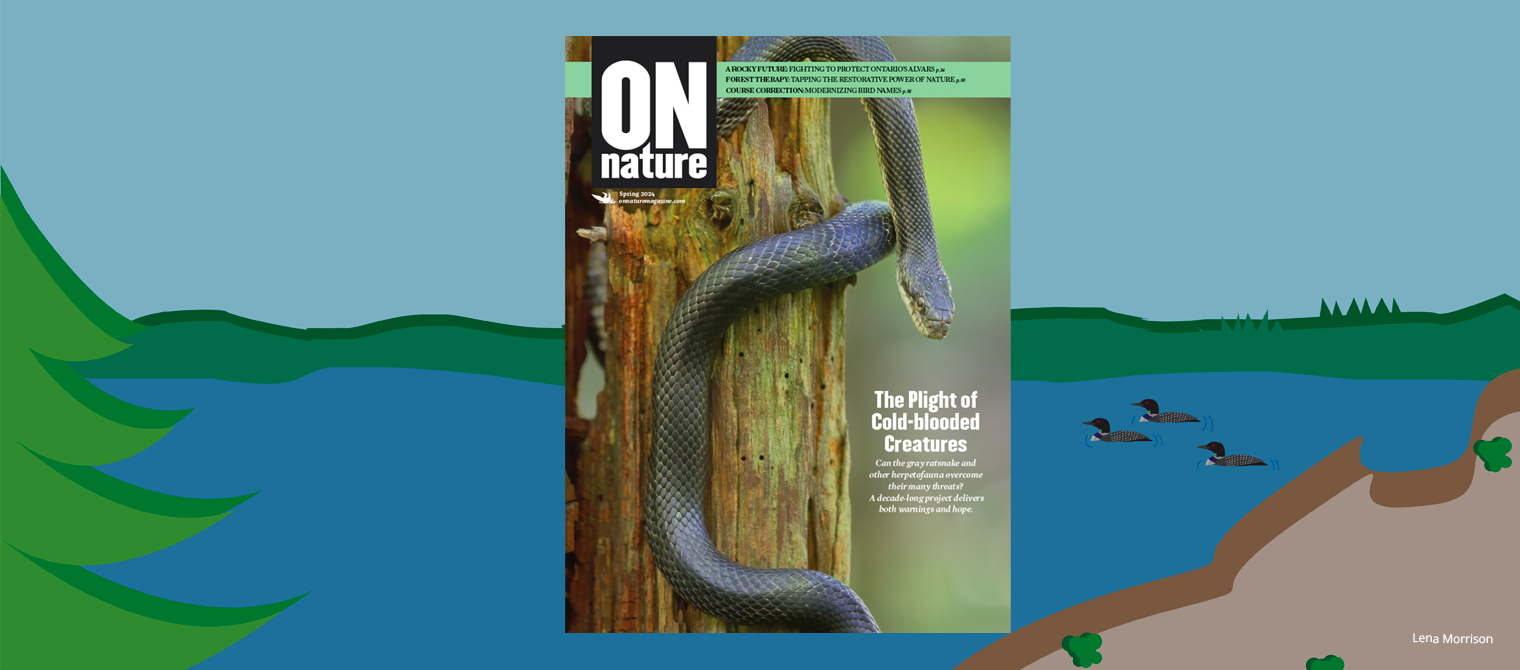
From Toronto to Thunder Bay, Ontario Nature staff have been travelling across the province in search of snakes, salamanders and other creeping, crawling and slithering wildlife. As part of the Ontario Reptile and Amphibian Atlas project, conservation staff have conducted workshops, presentations and field surveys to increase awareness of and gather data about this unique group of creatures. The goal is to learn more about where reptiles and amphibians can be found and their population sizes, largely through observations that members of the public submit. Read the full article…
Beetle mania
by Peter Gorrie
After nearly a decade of destruction due to a voracious, invasive insect, a glimmer of hope is stealing into Ontario’s gloomy ash forests.
The emerald ash borer has already destroyed most of its host trees in southwestern Ontario, specifically Essex County where this creature entered the province nine years ago. On its own, and with help from humans moving firewood and other wood products, the brilliantly coloured beetle has expanded its range eastward past Toronto. Read the full article…
Climate change economics
by Peter Rosenbluth
Many in the environmental community found that the recent provincial election was as notable for what was not discussed as it was for the points of contention. Absent from most debates was any discussion of conservation in an era of climate change. While candidates crossed swords over, for example, the applicability of the HST to the price of gasoline, no one considered the near future impacts of global warming on the enormous, yet fragile, northern ecosystems. Read the full article…
Follow the leader
by Joshua Wise
This summer, the Kitchenuhmaykoosib Inninuwug (KI) First Nation took a bold stance to protect the Big Trout Lake watershed by ratifying a watershed declaration and consultation protocol aimed at preserving 1.3 million hectares of boreal lakes, rivers, forests and wetlands that form the spiritual, as well as physical, centre of the community. Read the full article…
Carbon credit swap
by Allan Britnell
Most of us have known for years that trees are good for the environment, particularly because of their ability to sequester greenhouse gases spewed by cars and the other conveniences of our lives. Yet, until recently, no one knew precisely just how much carbon forests could store. But a detailed analysis published in the August 19, 2011, issue of the journal Science has cleared the air on how significant a factor forest-carbon capture is. Read the full article…
The problem with aggregates
by Caroline Schultz
A strong wind whipped in heavy grey clouds, and the threat of rain was imminent as several hundred shivering people queued up at the edge of a woodlot north of Shelburne at the beginning of a unique demonstration of civil society. They were lining up to protest against the proposed “mega-quarry” in North Dufferin County’s Melancthon Township and to raise funds to fight the application and to celebrate the area’s farmland and the food it produces. Eight hours and 28,000 people later, world-renowned chef and president of the Canadian Chefs’ Congress Michael Stadtländer had pulled off the coup he had planned: Foodstock, with 100 top chefs from across Ontario and beyond and an army of local volunteers.
Like most who attended Foodstock, I drove two and a half hours on roads and highways made of the very stuff that was the reason for this protest journey of thousands of Ontarians. The proposed quarry, which would be North America’s second largest, is the most recent in a long history of pits and quarries that have stirred public outrage. But this project is astounding in the way that the land was acquired from farmers and its sheer size and scale. The quarry would spread across 2,135 acres (937 hectares) and be almost 80 metres deep in places, bringing with it the spectre of major loss of some of Ontario’s best farmland, threats to ground and surface waters, and loss of wildlife habitat and other natural heritage.
Irish rock band U2’s 1987 song “With or Without You” could be the theme song for society’s relationship with the aggregate industry. As long as the population in this province continues to grow, we will need to feed it with the raw material for constructing roads, buildings and other infrastructure. Apparently, we can neither live without stone, sand and gravel nor live with the way these materials are produced. Or could we?
In his article on page 32, Ray Ford describes a new bend in the road of aggregate production in Ontario – a collaborative initiative of six environmental organizations and six leading aggregate industry players, including representatives from some of its heaviest hitters, to tackle the major sources of conflict between the environment and communities on one hand and the producers on the other. The Ontario
Aggregate Forum’s flagship initiative, a voluntary certification program based on rigorous environmental and community standards, has the potential to be a game changer, raising the performance bar well above the level required by regulation through creative and collaborative problem-solving and innovation.
Ontario Nature is a founding member of the Aggregate Forum. Over many years, we have fought the granting of specific aggregate extraction licences and worked to change legislation to protect natural heritage from the impact of pits and quarries. Now we are looking for something different. With more than 3,000 pits and quarries currently licensed in Ontario and many more in the pipeline, we need systemic change rather than fighting one-on-one battles. Sitting down with this industry to figure out how to make it “green” has been an interesting challenge but is an investment that may in the end reap great rewards. There will always be a need for occasional David and Goliath battles, such as the one in Melancthon Township, but we hope these will become increasingly rare – not because environmentalists and communities are depleted and defeated but because we have found a better way to protect our communities and environment.
Friend or foe?
Negotiating with former adversaries comes with a unique set of challenges.
by Julee Boan
In the early 1970s, a popular bumper sticker read: “If you are cold, hungry and out of work, eat an environmentalist.” At the time, and for many years after, an “us versus them” mentality dominated the discourse between tree huggers and corporate interests. The environmental community relied on a predictable bag of tricks to express opposition to destruction of habitat and wildlife that nearly always included a blockade along a logging road when forests were in jeopardy.
This approach proved to be a double-edged sword. On the one hand, it could be quite effective. The blockades in Clayoquot Sound during the 1990s saved significant old-growth rainforest in British Columbia. On the other hand, environmentalists were accused – not without some justification – of paying little or no attention to the subsequent spike in the unemployment rate when big operations or projects were cancelled. Even in cases where environmental safeguards have had no economic impact, environmental groups routinely are considered responsible for industry’s economic struggles. The result has been the false dichotomy of jobs versus the environment that unjustly forces communities to make tough choices.
As the historic Canadian Boreal Forest Agreement (CBFA) demonstrates, however, times are changing. Today, the new face of environmentalism has us rolling up our sleeves with industry, to figure out if and how we can have our cake and eat it too. In that agreement, nine environmental groups and 21 member companies of the Forest Products Association of Canada (FPAC) negotiated a ceasefire that will result in careful planning for 72 million hectares of boreal forest licensed to FPAC members. Moreover, through the agreement, members of FPAC are committed to high forest management standards in logged areas, while conservation organizations are committed to publicly recognizing and supporting the forest industry’s efforts.
After the agreement was signed, national organizations approached provincial environmental groups to assist in the implementation of the CBFA goals. Ontario Nature is one of the provincial organizations engaged in this challenging process, an undertaking that is not without its critics.
The fact is that, in northern Ontario, responses to the CBFA range from cautious hope and interest to fear, even anger. The concern is that big interests (environmental and industrial) mostly based in the south are making decisions that will affect northern residents without our involvement. Once again, the criticisms merit a hearing. When environmental groups partner up with former adversaries, do we risk losing meaningful connections with local concerns and grassroots support?
Some environmental groups are also skeptical of the process, arguing that the CBFA simply makes the consumption of wood products more palatable. The process appears to promote consumerism rather than straight-up forest conservation.
There are no easy answers. Nevertheless, while mounting blockades and waging “Do Not Buy” campaigns may create much-needed space for improved dialogue on forest values, they cannot deliver solutions. On the contrary, threatened woodland caribou that depend on the boreal forest have undergone population declines for decades – they are the harbinger indicating that forest management is falling short of our societal goals. An agreement like the CBFA provides market-based incentives for better forestry practices, an option well worth pursuing when direct opposition to logging has, in many respects, been insufficient.
In addition, the boreal ecosystem spans 750,000 square kilometres, an area so vast it can absorb some development. Rather than issue a blanket demand that logging stop, we can think in terms of thresholds – research indicates that caribou will persist where habitat disturbance affects less than one-third of their range.
Ontario Nature and other conservation groups know that we need agreement from First Nations communities – who have constitutionally protected Aboriginal and treaty rights – for any initiatives that involve changes to the landscape to be successful. We are already talking to several First Nations and listening to their priorities for lands and waters.
Here’s what Ontario Nature hopes to achieve: fully functioning boreal ecosystems that support strong and healthy communities. Already the CBFA can boast some significant achievements: industry has agreed to stop logging caribou habitat in portions of the southern boreal forest at least until 2013, creating opportunities for new approaches to forestry.
These types of negotiations – involving more than a dozen groups in Ontario – are neither quick nor straightforward. But we believe that with patience, persistence and goodwill, the goals set out in the CBFA can be achieved.
Julee Boan is Ontario Nature’s boreal program manager. She lives in Thunder Bay.
Our town
Transition cities are sprouting up across the province as urban environmentalists prepare for the triple threat of rising energy costs, resource depletion and climate change.
By Ivor Tossell
The movement that is changing the face of environmentalism started with a school project six short years ago.
Rob Hopkins, who taught permaculture (which includes the science of growing sustainable crops close to home) at a continuing education college in the rural town of Kinsale, Ireland, asked his class a question: The era of cheap energy is about to end, so what – right here, in this town – can we do to prepare for it? The students started with the premise that in 2021, their town would have half as much oil than is currently available, and that the price of energy would cause major disruptions in the global supply chains providing for almost all their needs.
His students created what amounted to a road map for the near future, a document packed with hundreds of recommendations – practical, incremental suggestions on how to prepare for daily life in a post-oil time. From competitions among towns to see which could grow the most food locally, to recycling standards for demolished buildings, to medicinal herb farms, to alternative currencies, the students took a no-stone-left-unturned approach to the transition they saw coming. “It is not the work of professionals,” Hopkins wrote in the resulting document, which he prosaically titled Kinsale 2021: An Energy Descent Action Plan. “It may occasionally be guilty of naivety, being misinformed or overly optimistic, but it is our attempt at starting this process rolling.”
The project did more than that. The document so impressed Kinsale’s town councillors that they adopted it as a guiding policy. In a few short years, the practical ethos of so-called Transition Towns spread to the United Kingdom and, from there, around the world. Transition Network, one of the websites devoted to tracking the movement, has plotted its spread: hundreds of local projects have sprouted globally in recent years, especially in Europe, North America and Australia.
Today, Transition Initiative groups are appearing across Ontario, in urban centres such as Ottawa and Toronto as well as rural areas such as Prince Edward County and mid-sized communities such as Peterborough and Guelph. The groups conduct seminars, hold festivals, run publications, share information, plant gardens and coordinate any number of small, local initiatives.
The popularity of the movement springs at least in part from the ripped-from-the-headlines urgency of its message: a triple whammy is coming in the form of the end of cheap oil, climate change and economic instability. To address it, a new strain of environmentalism has emerged that combines environmental concerns with a small-business sensibility and a streak of individualist self-sufficiency.
The Transition movement has no single creed; every local group seems to hew to a slightly different vision. But some themes are pervasive: community focus, local self-reliance and using less energy rather than seeking to produce more of it – or, as one activist succinctly put it, “more simple living.” Transition groups tend to work across a variety of disciplines, ranging from food security and energy planning to transportation and economic development, trying to foster local-scale innovations in all of them.
A three-point plan
The Transition movement unites a wide range of environment-related causes under its use-less, live-local mantra:
Food security: Anything that weans us from tractor-trailer-fed supermarkets helps. Growing sustainable crops locally is the highest priority. Urban agriculture, from tomato plants in the front yard to picking fruit from city trees, is big as well. Keeping chickens and other farm animals in backyards is an increasingly viable possibility. The key to resilience, according to Transition principles, is ensuring that reserves and supplies are available nearby.
Energy: Alternative sources of power are well and good, but reducing usage is priority number one in a low-energy future. This includes many actions, from reducing car travel in favour of cycling (a special challenge for rural Transitioners), to making sure that buildings are energy-efficient and encouraging governments to adopt tougher building-code standards. In areas where renewable energy is used, some Transitioners prefer decentralized, home- or community-based installations, such as small solar arrays, to large corporate initiatives like wind farms.
Economics: Transitioners believe that as globalization unravels, big business will be out and small business will be in. Building regional supply chains for local businesses will help drive that shift. So will encouraging one- or two-person enterprises to flourish. Keeping a network of local skills and trades is essential, as is mapping out who can do what in the community. Of particular importance are local food cooperatives and farmers’ markets, which provide a sales outlet for permaculture practitioners.
I.T.
Transition Guelph, for instance, has taken on a variety of small projects. Last spring, it launched a “treemobile” program through which fruit-bearing trees are planted around the city, and another initiative in which private landowners can have their urban fruit trees harvested and split the crop between owners and community kitchens. The Transition Guelph team launched two community gardens, working closely with other local groups. An alternative transportation group is working with bicycle shops to run bike-repair workshops, pushing maintenance capabilities out into the community. Yet another has undertaken the task of a “skills inventory” – a community registry of who has skills they would be willing to share, “everything from beekeeping to permaculture to darning socks,” says Chris Mills, the co-founder of Transition Guelph.
Since the Transition movement is polymathic by nature, it is well suited to serve as an umbrella for existing environmental initiatives, even lending them a new focus and urgency. “Often, Transition groups find themselves as hubs for things that people are already doing,” says Sami Grover, an environmental blogger who has written extensively about the movement. A Transition organization might, for example, bring the people spearheading a local-food movement together with those involved in social justice, and introduce both to neighbourhood businesses, says Grover.
The power of local networking is just as potent in the rural reaches of Prince Edward County, the picturesque peninsula on the shore of Lake Ontario, where environmental activism co-exists with the monster homes of wealthy retirees and the more pragmatic concerns of local farmers. “The part I’m really interested in is building a community that you can rely on,” says Christine Renaud, a member of the Prince Edward County Transition Group, which has been organizing lectures, many emphasizing self-reliance. The talks have covered everything from debt reduction to surviving economic turmoil to growing crops in winter and the finer points of producing sprouts.
The talks have found an audience among county residents who see the potential for a sustainable future – in some instances, by looking to the past. “At one time, ending in the late fifties and early sixties, Prince Edward County grew massive amounts of vegetables, and there were canning factories here,” says Myrna Wood, a member of the Prince Edward County Field Naturalists, an Ontario Nature member group and one of the groups that invited Renaud to speak to its members. “All of that was closed down as agriculture in Canada became industrialized.”
But Renaud sees networks of skills and cooperation as critical to communities’ survival in a precarious future. If rising oil prices cripple the corporate-run, long-distance supply chains that deliver our staples today, people will fall back on skills available locally, she says. “There’s also a kind of building of trust, and being able to have a good time with other people.”
The Transition movement has its survivalist streak, too. Indeed, if the movement has a watchword, it isn’t “sustainability” – a term some people consider to have been greenwashed by commercial overuse – but “resilience”: the ability to withstand the trials that are coming for our global infrastructure. “The whole world is rushing for sustainability, which is really not attainable in the lifetime of anyone living on the planet,” says Fred Irwin, the affable but blunt force behind Transition Town Peterborough. “It’s all about community resilience.”
To drive his point home, Irwin posits a familiar scenario gone awry: “What will happen if the power goes out for three hours – and then three days?” Three hours is nothing out of the ordinary. But extend that outage, and the Western world gets into trouble. As it turns out, Irwin says, Peterborough stores three days of food reserves. Like much of the country, the town is woefully ill prepared for prolonged blackouts or fuel shortages.
So Transition Town Peterborough, like others, is fostering community projects that will help build that resilience: a slow-food festival this fall, permaculture seminars and a quarterly magazine spreading the message. The organization is also building networks between small businesses. For many Transitioners, strengthening small, local companies is as important as establishing small, local food suppliers.
Will the Transition movement gain traction? In communities like Guelph and Peterborough, municipal and university officials have shown interest and offered support in the form of providing meeting space and sending officials to work with Transition organizers. The uptake in the general population, however, has been slow. Irwin says that local politicians understand the Transition movement as a community builder, but aren’t engaging with the broader shift away from oil. “It’s a hard sell in Canada,” says Irwin, noting that a vast, cold country with a dispersed population is an energy hog by default. “Emissions are going up, and energy demand is going up.”
But observers from other disciplines are taking note. “I frankly think that they’re really on to something,” says Lloyd Alter, a prominent Toronto architect and conservationist who blogs for Treehugger.com. “All of my studies over the last couple of years have been about how old buildings and old communities were designed before oil started running everything, and they will survive after. This is exactly what [Transition groups] are doing.”
Mills of Transition Guelph compares the movement to the minority in pre-war Britain who believed that war was coming and took steps to prepare for it by doing things like planting gardens and building bunkers – blazing a path for the general population. “When war did break out, people asked: ‘What did you do? And what do I do next?’” Thanks to the prepared few, says Mills, the rest of the country had an answer.
Ivor Tossell is a Toronto-based writer who covers urban affairs and technology.
Re-thinking native non-natives
In his letter, “A native non-native” (Autumn 2011, page 7) Don Scallen says that “black locust is not nearly as credible a threat as the other invasive plants featured in [Lorraine Johnson’s] article “Natural invaders” [Spring 2011, page 22].”
Those responsible for control of invasive plants have, by necessity, taken the nuanced approach that Scallen recommends because resources for controlling invasive exotic species are generally insufficient to control even the worst invasives. In a four-level classification of invasive exotic species in southern Ontario, black locust is classified as category two – not the worst, but definitely an invasive weed. Close to home, I have seen many areas completely dominated by black locust and forming impenetrable thickets – undesirable and very difficult to get rid of. In addition, all parts of the tree are toxic to livestock as well as people.
On the other hand, like other legumes, black locust harbours nitrogen-fixing microbes on its roots and consequently will grow in very poor soils, so it may be suitable for providing shade in areas where no other tree will grow (other than ailanthus, misnamed tree of heaven, another category two invasive). The native range of black locust does not come closer than Pennsylvania – considerably farther south than honey locust.
The honey locust, on the other hand, is a tree valued in urban forestry for tolerating urban conditions and light shade, and dropping leaves that disintegrate readily.
It is not invasive.
Bob Kortright, President, Toronto Field Naturalists
The pits
I am very concerned about the open pit quarry they want to put in the area of Shelburne, Ontario, in Melancthon Township. How are we going to feed future generations? They cannot eat the rocks they get out of the quarry.
Uta Bangay, Vankoughnet, Ontario
Toothless legislation
I promptly ended my reading of the Summer 2011 issue at page 15, completely outraged and exasperated at the seemingly useless status of Ontario’s laws for protecting nature. Four articles – “On guard for the moraine” (page 7), “A great deal” (page 8), “Coalition fights off construction” (page 14) and “Turtle hunting” (page 15) – made my blood boil.
I guess the question I’m asking is why are we sinking time, effort and money into working toward “protecting” places and species that, in the end, have no real protection at all? It’s not a “why bother” question, but rather a wakeup call about what we really need to be doing – pushing our lawmakers into making laws that have real teeth. Given all the legislation surrounding the Oak Ridges Moraine, the Niagara Escarpment and endangered species, one would expect them to be properly and completely protected, but they really and truly are not.
Given the current system, our natural places will gradually be nickel and dimed to death because, on the surface, our laws appear to be strong enough to protect vulnerable sectors, but in reality they are not. So our collective effort must focus on strengthening those laws by giving them real teeth, because if we don’t, everything we have done over the past decades and decades to come (short of spending billions to buy significant properties) will be for nothing.
Terry McDonald, Guelph, Ontario
Meet our board: Freeman Boyd
John Hassell You are a farmer with a PhD in philosophy. I would think that’s a rare combination. How did it come about?
Freeman Boyd I was raised on a farm in southwestern Ontario, which my family sold when I was 10. Later, during the back-to-the-land movement in the 1970s, I bought a piece of land in Grey County, which I converted into a farm and then worked for 25 years. Read the full article…
The Couchiching Conservancy
“We did not inherit this land from our fathers. We are borrowing it from our children.”
In southern Ontario, we have borrowed heavily from our children. The story is well known, if not well heeded: urban sprawl has paved over large tracts of green spaces at an alarming rate.
The Couchiching Conservancy has met this challenge head on by managing 10,000 hectares of protected land, with title to nearly 4,000 hectares. The protected land constitutes the most sensitive and threatened landscapes surrounding Orillia, mostly located on the Oro Moraine and the Carden Plain. Guided by their Natural Heritage
Action Plan, the group owns 17 properties and looks after another 11 through easements and partnership agreements with other conservation organizations such as the Nature Conservancy of Canada.
With strong support from the public, the Couchiching Conservancy is able to work closely with landowners, ranchers, residents and other stakeholders. Past president Gord Ball describes the Couchiching Conservancy as “an organization that people feel good about,” an assessment with which many people familiar with the group agree.
The extensive hardwood forests of the Oro Moraine contain the groundwater for surrounding wetlands and streams, and also provide drinking water for thousands of local residents. The Carden Plain is a rich mosaic of globally rare alvars, grasslands, shrublands and wetlands. It is also a birding mecca and habitat for one of Ontario’s last known breeding populations of the eastern loggerhead shrike, a bird that has the unique habit of impaling its prey on thorns and barbed wire. In 1998, the Couchiching Conservancy successfully nominated the plain as a nationally significant Important Bird Area (IBA).
Given the rapid growth in population and development in southern Ontario, the success of the Couchiching Conservancy in protecting significant habitat is all the more important. This group is actively making good on the debt we owe to our descendents.
For more information about the Couchiching Conservancy, visit: www.couchconservancy.ca.
Here be giants
First overfishing, then hydro dams. Lake sturgeon, Ontario’s largest and longest-lived fish, now belongs to one of the most beleaguered groups of animals on the planet.
By Peter Christie
Tim Haxton shifts his chair to allow his visitor a better view of the photograph on the computer screen. The dark image of a fossilized fish makes a subtle “S” in the lighter brown mud-stone that surrounds the shape. It is as if the creature suddenly turned to stone during a lazy swim through murky water. The petrified details – even the fine rays of fins – are crystal clear, and the identity of the fish is unmistakeable. “Sturgeon,” confirms Haxton, a fisheries specialist with the Ontario Ministry of Natural Resources (MNR). “This one is probably about 200 million years old, from the Jurassic period. They really haven’t changed much in form or function since.”
The soft-spoken biologist has collected hundreds of photos during his 15 years of studying lake sturgeon, Ontario’s largest and longest-lived fish. His picture of the fossil, however, adds an almost mind-boggling historical view to our discussion of sturgeon conservation: close ancestors of this formerly indomitable animal were swimming the world’s waters before the Atlantic Ocean was born, before birds flew and about 200,000 millennia before humans first appeared. They swam right through the great extinction of the dinosaurs and, despite volcanic eruptions, ice ages and other climatic calamities, have overcome every threat they encountered – until now.
Sturgeon today confront a higher risk of extinction than any other non-insect animal in the world, says Haxton, citing the conclusions of a 2010 workshop of the International Union for Conservation of Nature (IUCN). Decimated by periods of overfishing and prized for their eggs, which are sold as expensive caviar, many sturgeon populations around the globe have been in free fall for decades. All 27 sturgeon species – including lake sturgeon – are on the IUCN’s Red List of Threatened Species. Two-thirds of these are considered “critically endangered” because their plummeting numbers or shrinking, fragmented ranges mean that the odds of this fish disappearing for good are “extremely high.” Four sturgeon species may already be gone forever.
Which is why, Haxton says, conservation of Ontario’s lake sturgeon is so crucial. These fish are better off than many sturgeon species but have troubles of their own. In 2009, two of the three populations of lake sturgeon – the only type of sturgeon found in Ontario – were listed as threatened on the province’s Species at Risk roster. The other, most northerly population is considered of special concern. In the Great Lakes in particular, stocks of this now rarely seen fish never recuperated after an overzealous fishery a century ago reduced their numbers to a fraction of their former population. Meanwhile, human interference seems to be hampering their recovery. The worst culprits are hydro dams, whose number is expected to surge as the province pushes for more renewable energy (see “Waterpower,” facing page).
All this only makes Haxton’s main point more significant: the lake sturgeon that live in at least 128 lakes and reservoirs and 101 rivers across Ontario (as well as sturgeon in parts of Quebec and Manitoba) represent “the last, good remaining stock of pristine sturgeon anywhere in the world.” They are, in other words, possibly the final hope for one of the oldest and most beleaguered groups of animals on the planet.
“That’s what I’m trying to get across,” he says. “We have one of the few bastions left.”
Waterpower
For the Ontario Rivers Alliance, lake sturgeon is something of a poster fish. The coalition of local and environmental groups was formed in early 2011 to warn people about changes to Ontario’s rivers, whose health is threatened by scores of proposed new hydroelectric projects. The potential impact of dams on sturgeon is just one of the group’s concerns, but the fish symbolize other worries, such as strangled, unnatural river flows and murky, mercury-infused water. “This is like a green energy rush,” laments Linda Heron, chairperson of the alliance. “We’re hurtling forward without really thinking this through at all.”
Heron is referring to the Ontario government’s 2009 Green Energy Act and the guaranteed pricing for renewable power (the feed-in-tariff, or FIT, program) it introduced. The program made hydro development economically viable on rivers where these projects would have been unthinkable in the past. Since September 2011, 102 new hydro projects have applied for approval by the Ontario Power Authority (OPA), which administers the FIT program. Although none of these projects have been built so far, as of September the OPA had given a go-ahead to 49 projects. The new ventures would mean that, within a few short years, the province will have significantly more than the approximately 200 waterpower facilities currently operating, which supply about a quarter of Ontario’s power.
The industry argues that any environmental harm to the rivers will be minimal. “We are confident that Ontario’s very rigorous class environmental assessment will ensure any impacts from dams or other aspects of these projects will be carefully considered and minimized,” says Colin Hoag, a policy advisor with the Ontario Waterpower Association, an industry organization representing hydro companies. The alliance is not convinced. The group – which includes such organizations as Algonquin Eco Watch, Friends of Temagami, the French River Stewardship, the Canadian Parks and Wilderness Society (Ottawa Valley), Whitewater Ontario and almost a dozen others, along with many individuals – is concerned that the political push for renewable energy is putting pressure on the Ministry of Natural Resources and the Ministry of the Environment to overlook their responsibility to safeguard the integrity of Ontario rivers. “Rather than protectors of our environment, these ministries have become more like facilitators for industry,” argues Heron.
This fall, the Ontario Rivers Alliance challenged the first environmental assessment (EA) completed for a FIT hydroelectric project – a generating station proposed for the Ivanhoe River about 100 kilometres west of Timmins. They have launched another challenge to a similar project on the Serpent River and a third is in the works. The group says the environmental safeguards for waterpower projects under the “class” EA guidelines tailored for the hydro industry are not demanding enough. It’s asking the government to require an independent (non-industry) EA that considers what the alliance hopes will be a wider range of potential environmental impacts.
Hoag disagrees, arguing that the class EA provides ample protection for Ontario’s rivers. “We have a great assessment process,” he says. “Compared to a lot of other jurisdictions, Ontario is very progressive.” Ultimately, the Ontario Rivers Alliance wants the government to seriously consider the conundrum that being progressive about greenhouse gas emissions could mean other environmental concerns drift downriver without a paddle.
Peter Christie
If lake sturgeon are a living link to our primeval past, they certainly look the part. Lead grey or deep, primordial brown, adult sturgeon appear to belong to another time. Their skin is without scales and leathery, and their fins set back toward their sickle-like tail. Mature sturgeon are huge, frequently a metre or more long. Some are giants, reaching a length of four and a half metres and weighing up to 185 kilograms (the weight of a small piano). Despite their size, lake sturgeon inhabit the relative shallows (between five and 10 metres deep) where they patiently scour the bottom, using four sensory barbels hanging near their noses to locate insect larvae, snails, crayfish, clams and sometimes small fish. Like sharks and other ancient fish, sturgeon have a skeleton of cartilage instead of bone and move with an almost fluid gracefulness. Also like sharks, these prehistoric fish have a long snout, and their eyes are eerily black.
“The first European settlers hated them,” says John Casselman, an adjunct professor at Queen’s University and a former senior scientist at MNR’s Glenora Fisheries Station near Picton. Before the mid-19th century, vast numbers of sturgeon swam in the clear water of the Great Lakes and its undammed tributaries, and were despised for fouling nets and gear set for trout and other, more useful species. (The settlers’ view of sturgeon was in sharp contrast to the centuries-old beliefs of many Ontario First Nations people, who revered it as a source of food, oil and leather, and celebrated it in rituals and legends.) Fishermen stacked “nuisance” sturgeon onshore by the thousands and left them to dry, later to be used as furnace fuel for steamships.
The high road
In a groundbreaking alliance, the aggregate sector and conservation groups, led by Ontario Nature, make common cause on a green certification standard for gravel.
By Ray Ford
It has been a decades-long cold war, with some very hot engagements. But the struggle between Ontario’s $1.3-billion sand, gravel and stone industry and the people seeking to safeguard the province’s landscape, could, at last, be reaching a detente.
That may be tough to believe for residents of Dufferin County, where the application for a mammoth 937-hectare Melancthon Township quarry in the heart of Ontario’s potato-growing country (see “The big pit,” Autumn 2011) seems to indicate the conflict is scaling up. The bid elicited more than 2,000 objections, sparking marches and a tractor convoy, and inspiring Foodstock, a culinary demonstration sponsored by the Canadian Chefs’ Congress. This sort of opposition is not cheap, especially when donations come in $20 and $50 at a time. But North Dufferin Agricultural and Community Taskforce vice-chair Carl Cosack promises that if the quarry’s backers “are willing to go down to the wire, we’ll meet them, step for step.”
Yet even as new battles brew in parts of the province, potential for a new accord exists between industry and environmental groups – one that could result in gravel being extracted in a greener, more sustainable way without generating the kind of confrontation inherent in the present system. Taking the lead in the effort is the Ontario Aggregate Forum, founded by members of both camps in 2008. “We’re looking for a more systemic way of lessening the impact of aggregate extraction,” says Caroline Schultz, executive director of Ontario Nature and the organization’s representative on the forum.
The forum hopes to have the basic outlines of a plan for greener aggregate extraction next year and has already hired consultants from Deloitte to scan the world for leading standards and practices. For Bob Patrick, president of the Coalition on the Niagara Escarpment (CONE) and the coalition’s representative to the forum, the process could yield third-party environmental certification similar to that in place for lumber, paper, coffee and seafood.
If petroleum is the lifeblood of modern society, aggregates – including sand, gravel, stone, earth, clay and shale – form the bones. In 2009, the last year for which complete figures are available, Ontario’s pits and quarries produced 153 million tonnes of aggregates (almost 12 tonnes per person) for use in everything from roads, bridges and sewers to buildings and foundations, glass, paint, paper, fertilizers, even pharmaceuticals.
These resources take a heavy toll on the environment. Even with a sensitive rehabilitation after a pit or quarry has been played out, extraction is a permanent eviction for the plants and animals originally on the site. Then there are the problems with dust, noise, lighting and truck traffic, potential changes to the filtering and storage of groundwater, and carbon emissions. Every kilometre a gravel truck travels adds about 1.5 kilograms of greenhouse gases to the already burdened atmosphere.
“If you look at all the stresses on the landscape, aggregate extraction is significant,” says Schultz. “It all boils down to growth and urban sprawl, where we build and where roads are needed. Growth is the monster that needs to be fed.”
Where the aggregates go
The amount of aggregate used in various construction applications:
- kilometre of a two-lane highway: 18,000 tonnes
- 2,000-square-foot house: 250 tonnes
- kilometre of a subway line: 114,000 tonnes
- kilometre of water main: 1,000 to 4,500 tonnes
(Source: State of the Aggregate Resource in Ontario Study, 2010)
The fact that industry and environmentalists have come together to tackle these issues is a near miracle, considering that the two sides have spent decades, as Ron Reid of the Couchiching Conservancy says, “tossing bricks over the wall at each other.” Members of the forum are familiar with the sort of bitter, protracted and expensive dispute now taking place in Melancthon. When CONE and Halton-based Protecting Our Water and Environmental Resources (POWER) teamed up to fight the 2004 expansion of Dufferin Aggregates’ Milton quarry, the $175,000 bill “basically bankrupted us,” Patrick says. Hobbled by debt and without the cash to maintain fulltime employees, “we’ve been limping along ever since.”
Industry has deeper pockets, but also larger bills. “We have to buy land on speculation and hope we can get approval” to mine it, says Ken Lucyshyn, another forum member and vice-president of aggregates and construction for Walker Industries, based in Thorold. His firm has spent more than $10 million on a quarry application in Duntroon and, after six years, has yet to receive a go-ahead. A delay of that length is not unusual for large and contested proposals that, like the Duntroon application, are appealed to the Ontario Municipal Board (OMB), the province’s land-use adjudicator. “When you go through a months-long OMB hearing and spend millions,” says Moreen Miller, president of the Ontario Stone, Sand & Gravel Association, “to me that’s a colossal waste of energy, money and time.”
Where the aggregates are
The Greater Toronto Area uses about one-third of Ontario’s aggregate, so it’s no surprise the province’s top aggregate-producing municipalities are mostly clustered in southern Ontario. Although Ottawa is the number one municipal producer, other top 10 producers are Hamilton, Kawartha Lakes, Clarington in Durham region, Milton and Caledon.
While areas with the highest populations tend to demand the most aggregate, they also face a wide range of competing priorities, including natural heritage protection, agriculture and the concerns of local residents. The Ministry of Natural Resources 2010 State of the Aggregate Resource in Ontario Study notes that land-use plans for the Niagara Escarpment and the Oak Ridges Moraine either outlaw or restrict the expansion of pits and quarries across significant swaths of those areas, even though each contains high-value aggregates. For aggregate producers and users, then, the challenge lies in finding suitable rock while limiting the environmental impact of its extraction. Given the difficulty in getting approval for new sites, the report notes, “the majority of the reserves supplying the GTA market are coming either from moderate or scarce reserves.”
Ray Ford
Picture perfect
by Sharon Oosthoek
If a sasquatch were suddenly to walk out of the forest, you should try to squeeze off a few pictures, jokes nature photographer Robert McCaw. More typically, though, the best images are a result of planning, patience and a solid understanding of the habits of the animal you are trying to photograph. Read the full article…
Sprinter, hunter, player
Neither a glamorous creature nor a pest, the playful tiger beetle is an understudied insect despite its fascinating ways.
By Jean Godawa
After basking on a narrow blanket of sandy soil in the late-morning sun, the tiny creature stood up and stretched its legs. As I walked forward, my quarry ran away – not far, just a few metres ahead – then turned to face me, as if daring me to follow. I did, and the game continued. Such behaviour is typical of tiger beetles and those of us curious enough to want a closer look.
Beetles have fascinated us for thousands of years. Ancient cultures worshipped them; international organizations study and protect them; people even wear them as living jewellery. Found in almost every habitat, beetles are the largest animal group on earth, comprising well over 300,000 species. Their wide range of food sources (from rotting corpses to flower petals) and their almost limitless variety of sizes, colours and shapes also distinguish them. Despite this multiplicity, beetles are easily recognized by one feature: the elytra, a pair of hard forewings that meet in a straight line down their backs, protecting the more delicate and membranous hindwings underneath. Tiger beetles’ elytra is especially spectacular, varying in colour and pattern from the iridescent green of the common six-spotted tiger beetle (Cicindela sexguttata) to the perfectly camouflaged, mottled appearance of the rare, sand-dwelling ghost tiger beetle (C. lepida).
Scientists believe 14 species of tiger beetles live in Ontario, each one found in a specific habitat at a specific time of year. What sets them apart from most other beetle species is their pronotum – a section located above the base of the elytra – which is noticeably narrower than both the elytra and the head with its large, bulging eyes.
A tiger beetle is difficult to identify by its appearance, but its behaviour, location or the season will help disclose its identity. My recent experience with the seemingly playful beetle, on a sandy path along the East Don River, demonstrated one of this creature’s distinctive traits. Tiger beetles are incapable of maintaining a constant internal temperature, so they take advantage of ambient conditions. They bask in the sun to heat themselves, soaking up the necessary warmth to remain active for hunting later in the day. To avoid overheating, they raise themselves on their long legs, and this tiny elevation allows air to flow between the ground and the beetle, producing a cooling effect.
The game of beetle tag was also typical of this species. The beetle was not so much daring me to chase it as trying to see my position. Tiger beetles run so fast, they experience temporary blindness. They have to stop and reorient themselves to the location of predators and prey. Some beetle species can reach speeds of up to 2.5 metres per second, which is equivalent to over 100 times their body length per second. In comparison, the fastest human sprinter runs about six times his body length per second.
Despite their visual challenges, tiger beetles are skilled and fearsome hunters whose predatory methods are similar to those of their feline namesakes. These beetles quietly wait for ants, spiders and other ground-dwelling insects to appear, then pounce on the victim and devour it with their impressive mandibles. The strong, curved mouthparts of the adult tiger beetle have sharp edges for grasping and consuming prey. The feeding behaviour of the immature, or larval, beetle is just as efficient and deadly. The grubs live in vertical burrows underground. They wait at the top of the tunnel with their head level with the surface, grabbing insects that pass by. Hooks on the larva’s abdomen anchor it in place inside the burrow, ensuring its safety if a struggle with the prey ensues.
Most Ontario tiger beetles have a two-year life cycle. After spending the winter in an underground burrow, adults emerge in the spring to mate, lay eggs and then die. The female deposits her eggs underground, where they hatch and the larvae remain. Larvae go through three growth periods, known as instars. Prior to each instar moult, a larva will enlarge its burrow in preparation for an increase in its body size. Tiger beetle larvae usually complete two instars in the first year. They spend the winter and the following summer in their third instar and pupal phases. By late summer, the adults emerge. They overwinter underground and resurface the following spring.
My tiger beetle encounter was fortuitous. These are elusive creatures, and a person has to be in the right place at the right time to see one. In spring, a patch of sun on a forest path is the perfect place to await a six-spotted tiger beetle, which is common throughout Ontario, even in urban parks. Most other species, however, inhabit the sparse vegetation or sandy conditions of dunes, mud flats or alvars. Some stick to very specific locations within the province and are at serious risk from habitat alteration, such as the encroachment of non-native species. Some species are increasingly rare and their habitats threatened.
For example, the Laurentian tiger beetle (C. denikei), a striking and extremely rare tiger beetle, is limited to the western border of the province and Manitoulin Island. The hairy-necked tiger beetle (C. hirticollis) can be seen only on the shores of the Great Lakes and the Ottawa River. Lambton County, including Pinery Provincial Park on the southeast shore of Lake Huron, is the sole known habitat of the northern barrens tiger beetle (C. patruela), a remarkably beautiful insect whose status was classified as endangered in 2009.
The rare ghost tiger beetle, thought to exist only in Norfolk County and the Ottawa Valley, was found in 2004 in Northumberland County during field work by Todd Farrell, conservation biologist with the Nature Conservancy of Canada. The species sticks to sandy inland areas and currently inhabits a tract of ecologically significant land near Rice Lake as well as in Norfolk Sand Plain and the Ottawa area. These spectres were a welcome sight to Farrell. Although ghost tiger beetles are not endangered or threatened in Ontario yet, Farrell says the spread of invasive species such as knapweed and Scotch pine in the area and the disturbance of open sandy habitats threatens their continued survival.
Finding and documenting new populations of tiger beetles is vital to keeping them with us. They’re not economically significant species, nor are they pests – the two reasons why insects usually receive policy-makers’ attention. Nonetheless, these beetles are important parts of their ecosystems. As predators, they keep grasshopper, caterpillar and other insect populations in check; as prey, they provide food for dragonflies, frogs, birds and other small animals. Because tiger beetles require such specific habitat, they also serve as barometers of environmental health. As Tom Mason, curator of invertebrates and birds at the Toronto Zoo, points out, the disappearance of a habitat-specific species is a strong indication of ecological degradation.
Nature enthusiasts often participate in tracking butterflies and moths, but monitoring other insects tends to fall to the experts because many species are hard to identify, sometimes requiring a dissection to confirm their identity. No extensive entomological knowledge is needed to recognize tiger beetles, however. While the air is cold and snow covers the ground, they remain in their underground burrows awaiting the first signs of spring. Watch for them on warm April days. A tiny flash of green on a sunny forest path could be a tiger beetle challenging you to your own game of tag.
Jean Godawa teaches insect biology and ecology through workshops and lectures, focussing on the importance of these often-misunderstood yet vital creatures.
Residents on our reserve
by Gerard Keledjian
It’s confirmed. Nesting peregrine falcons are living on what will soon be Ontario Nature’s newest nature reserve, Malcolm Bluff Shores. The Ministry of Natural Resources (MNR) recently verified that a pair of peregrine falcons, which Ontario Nature staff discovered by accident, is nesting in the Midhurst area, the only documented nest in a natural setting in that area. The falcons – designated as threatened on the Species at Risk in Ontario (SARO) List – use various parts of the cliff in the reserve for perching and hunting, so the whole cliff face is considered to be critical habitat. Read the full article…

Julee Boan is Ontario Nature’s boreal program manager. She lives in Thunder Bay.


